About Our Art

“Beauty is a key to the mystery and a call to transcendence.”
—St John Paul II, Letter to Artists (§16)
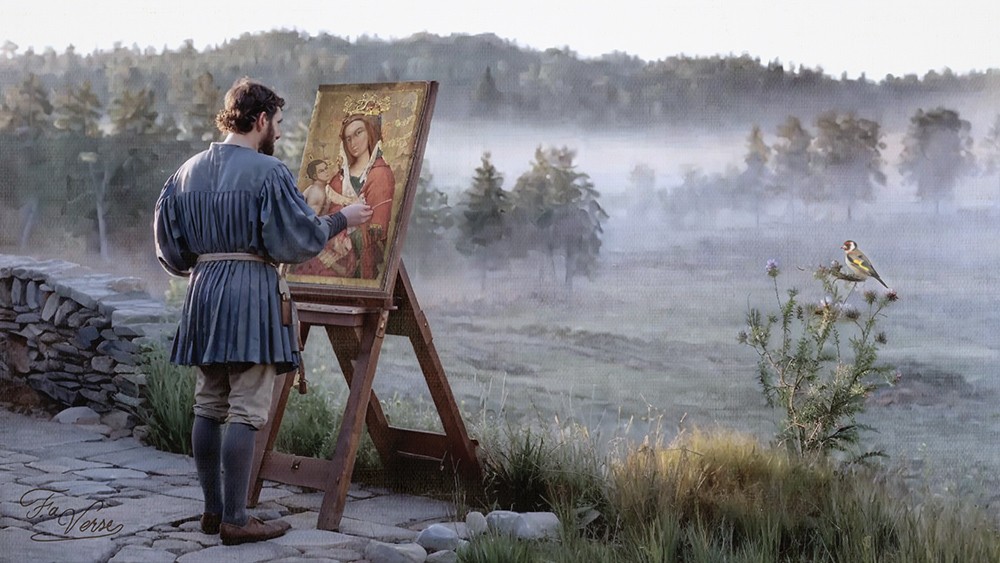
The Master of Vyšší Brod at work—painting the Madonna of Veveří in a Bohemian landscape as a goldfinch watches.
The artist remains unknown; the craft and the icon endure.
Faith and Verse creates traditional Catholic sacred art through digital means,
grounded in historical research and devotional intent.
Faith and Verse is shaped by prayer, study, and artistic discipline. We do not aim to reconstruct history, but to bear witness—with spiritual credibility and sacred focus.
We avoid fantasy and sentimentality, and seek instead a style of sacred realism rooted in Christian tradition.
Where historical accuracy is possible, we honour it. Where Christian symbolism offers enduring forms, we use them with discernment. Every artistic decision is made in light of silence, Scripture, and reverence.
The painters of the Medieval, Renaissance, and Baroque eras placed saints in the settings and garments of their own time. They did this not from neglect, but from devotion: they served the mystery with the means and knowledge they had. Their task was to make the holy visible using the world familiar to them. With the historical resources available today, it is reasonable to think the old masters would have welcomed them, for they themselves studied ruins, coins, and whatever traces the past had left to paint with fidelity.
Sacred art in our age sometimes continues those visual habits simply because they feel familiar. Yet familiarity alone does not reveal the world in which the saints themselves walked. When we depict a 9th-century saint, or a young girl from the 9th century BC, or a figure of the early Church, we try to let them stand in their own world
—not in a later century’s devotional imagination. Not as an attempt to correct the old masters, but as a continuation of their intention—to serve the truth with what we have been given.
They walked among ruins, coins, relics, and the memory of their forebears.
We walk among archives, scholarship, and centuries of sacred study.
To set all this aside would feel, to us,
like a quiet betrayal of the very impulse they lived by.
Artistic Direction
The Light Comes to Them
“He was not the light, but came to bear witness to the light.”
—John 1:8 (RSV2CE)
In our sacred imagery, saints do not glow as though the light originated within them. When light carries symbolic weight, it still belongs naturally to the world of the image—from the sun, a window, a candle, or the open sky.
The light comes to them. They receive it.
This allows symbolism to remain within realism. The saints do not shine by their own power. They receive the light of the Creator and, at times, seem almost to bathe in it—the light suggesting mercy, grace, the presence of Christ, and the quiet action of the Holy Spirit. It may fall more clearly upon a face, a habit, a hand, or the path before them, but it remains natural within the world of the image. They are not the source of the light. They receive it, live within it, and bear witness to it. That is why we call them Witnesses to the Light.
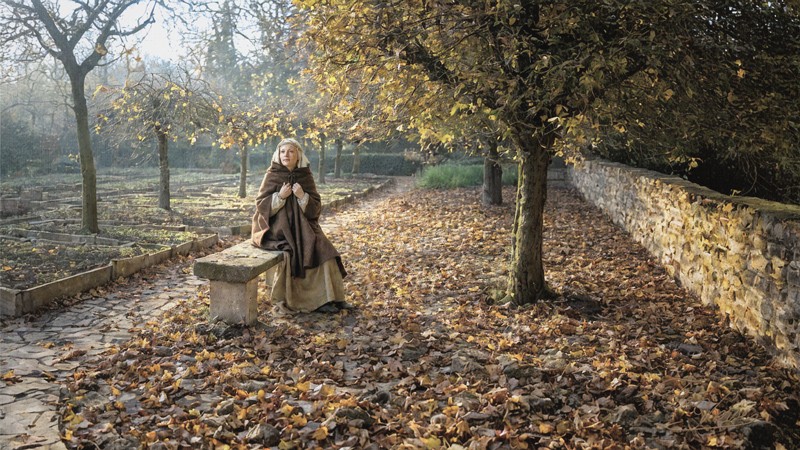
Saint Aldegundis in the autumn garden
—the light falls naturally upon her face and habit. She receives the light; she is not its source.
Our work is not modern religious art.
It is a return to the sacred—in form, in tone, and in heart.
Images composed in Adobe Photoshop from components produced using Ideogram.ai, Adobe Firefly, original photography, and/or manual sketching.
Stylistically unified using Stable Diffusion 1.5—Realistic Vision V6 in ComfyUI.
Painterly finishing completed in Adobe Photoshop using a Wacom tablet, manual painting, and retouching workflows.
Production Notes

A Carolingian wooden bridge built upon Roman stone foundations along the King’s Road
—humble craft resting on ancient strength, marked with the sign of Christ.
Contact regarding our work
For corrections of historical or symbolic errors—or for inquiries about permissions, technical process, or specific depictions—use the form below.