

ENTER OUR VIDEOS
RECEIVE OUR WORK
Enter the full collection of our
tributes to Saints on YouTube.
Be notified quietly by email of our prayers,
reflections and new videos, free of charge.
Saint Bonaventure of Bagnoregio
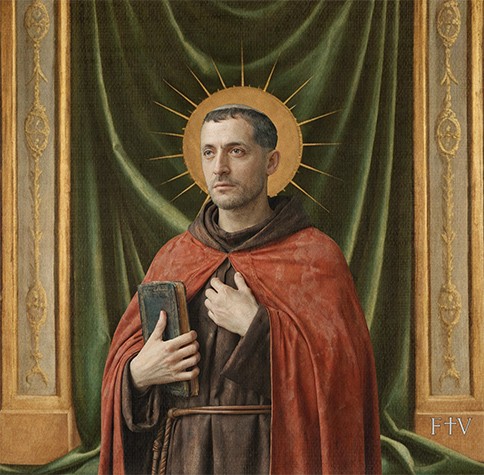
Born: c. 1217/1221, Bagnorea (Bagnoregio), Lazio, Italy
Died: 15 July 1274, Lyon (in what is now France)
Traditional Feast Day: 15 July—Honoured for his theological wisdom, Franciscan reform, and contemplative writing.
Modern Roman Calendar Feast Day: 15 July
Canonized: 14 April 1482 by Pope Sixtus IV
Declared Doctor of the Church: 14 March 1588 by Pope Sixtus V
Honorific Title: Doctor Seraphicus (Seraphic Doctor)—a title linked to the fiery love of God that pervades his teaching.
Honored for: Faithful service as Franciscan Minister General, preservation and reform of the Franciscan Order, mystical theology of ascent to God through charity, and defense of mendicant poverty during the thirteenth-century university controversies.
Patron Of: Theologians, students, teachers, Franciscans, those seeking wisdom in faith.
Symbols in Art: Franciscan habit, cardinal's hat, book, crucifix, seraph, communion chalice, incorrupt tongue.
Invoked For: Wisdom united to charity, humility in learning, perseverance in leadership, contemplative prayer, guidance in theological study, unity in the Church, and the grace to see all knowledge as leading to God.
Saint Bonaventure of Bagnoregio–Patronage & Symbols
Giovanni di Fidanza, Bonaventura da Bagnoregio, Doctor Seraphicus

Is Saint Bonaventure Patron of Bowel Disorders?
Traditionally—no.
Recent devotional literature sometimes lists Saint Bonaventure as patron of bowel disorders or digestive ailments. This claim appears in devotional sources from the 2010s and has since spread through online prayer sites. No earlier source—medieval, early modern, or even twentieth-century—mentions such a patronage.
Bonaventure's own account in the Legenda Maior (c. 1263) records only that he was "snatched from the jaws of death" by Saint Francis's intercession as a child, without specifying the illness. The 1907 Catholic Encyclopedia likewise notes a "dangerous illness" but mentions no intestinal affliction.
Traditional sources tie his patronage to theologians, students, and the Franciscan Order—never to bodily functions. The bowel disorder patronage appears to be a recent development in popular devotion, yet has spread rapidly across hundreds of websites, prayer manuals, and commercial sources, often presented as established tradition rather than a modern phenomenon.
Breviloquium (1257)
A compact summary of Christian doctrine, written for students and friars. Covers theology, creation, sin, redemption, and the sacraments in clear, accessible form.
Itinerarium mentis in Deum (The Soul's Journey into God, 1259)
Bonaventure's mystical masterpiece, outlining the soul's ascent to God through contemplation. Written at La Verna, the mountain where Saint Francis received the stigmata.
Legenda Maior (The Major Life of Saint Francis, 1260–1263)
The official Franciscan biography of Saint Francis, approved at the General Chapter of Pisa in 1263. Became the authoritative narrative of the Founder's life.
Apologia pauperum (Defense of the Mendicants, 1269)
A vigorous defense of mendicant poverty and the Franciscan vocation, written in response to renewed attacks on the friars' way of life.
Collationes in Hexaëmeron
(Conferences on the Six Days of Creation, 1273)
Bonaventure's final theological lectures at Paris, using the scholastic method to warn against intellectual pride and sterile disputation divorced from charity.
Major Works of Saint Bonaventure
Born around 1217 in the hill town of Bagnoregio in Lazio, Giovanni di Fidanza entered the world at the height of the mendicant renewal that was reshaping the thirteenth-century Church. He would become known as Bonaventure—Franciscan master at the University of Paris, Minister General of the Friars Minor for seventeen years, Cardinal-Bishop of Albano, and in later memory the Doctor Seraphicus, the Seraphic Doctor, a title that captures the burning love of God at the center of his teaching.
Remembering Saint Bonaventure
Early Life and the Franciscan Call
As a boy, Giovanni fell gravely ill—so gravely that his life was despaired of. His mother sought the intercession of Saint Francis of Assisi, and the child recovered. Bonaventure himself records this moment, and it marked him for life. The illness, the prayer, the healing: these became the first coordinates of his vocation.
He went to Paris for study, received the Master of Arts, and in about 1243 entered the Friars Minor, taking the name Bonaventure in religion. He studied under Alexander of Hales, the Franciscan master who had introduced Aristotelian philosophy into the theological curriculum. He entered the demanding theological curriculum of the University of Paris, lecturing on Scripture and on Peter Lombard's Sentences, and ascending to the Franciscan chair in theology.
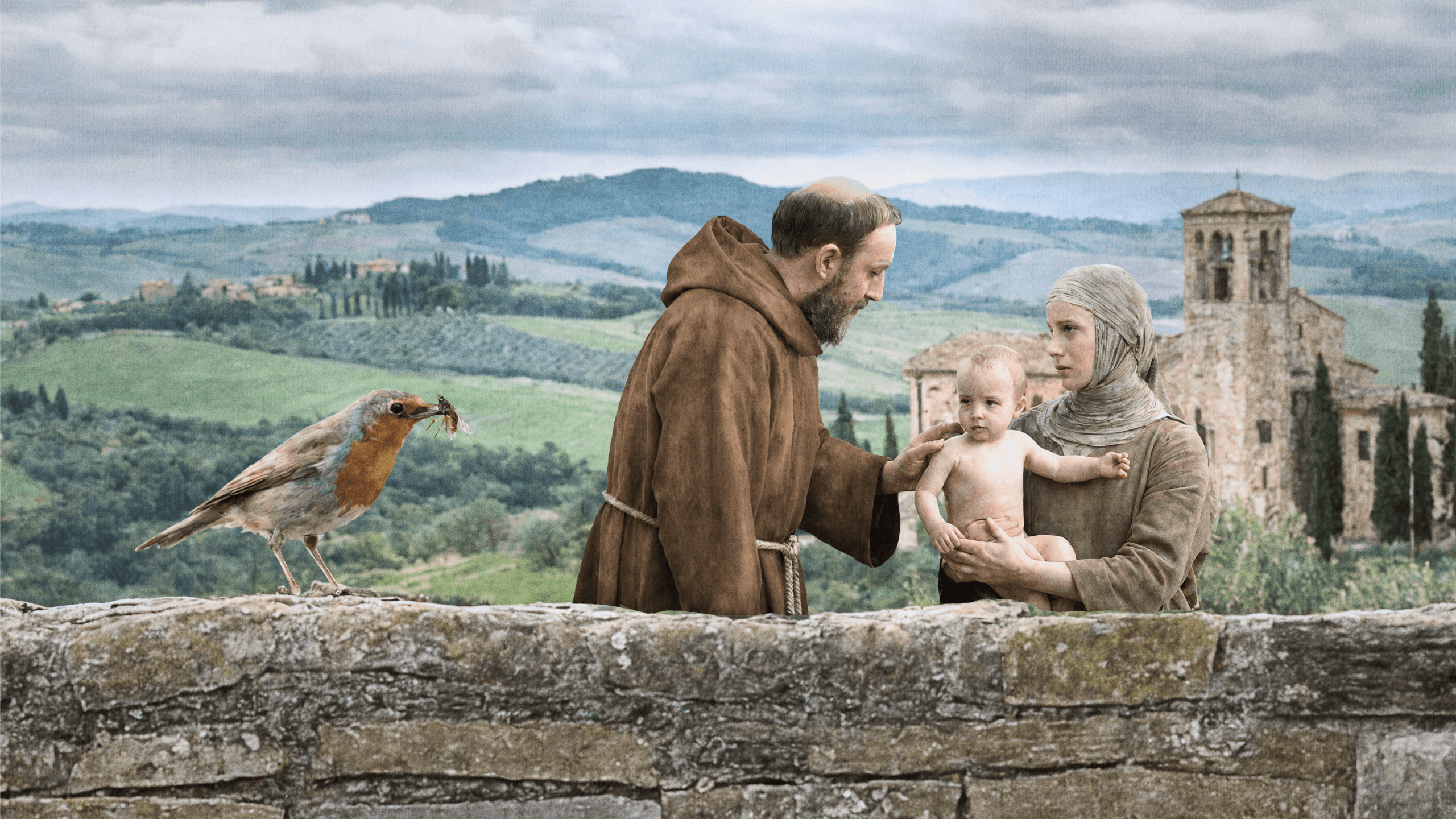
The infant Bonaventure, gravely ill, is held by his mother as Saint Francis of Assisi touches the child in a moment of miraculous healing. A robin, bearing brown and red in its plumage, perches nearby.
Paris Conflict and the Defense of the Mendicant Life
The 1250s brought violent controversy to the University of Paris. Secular masters launched attacks against the mendicant orders, challenging their right to hold teaching chairs and questioning the legitimacy of their consecrated life itself. The conflict was not merely academic: it struck at the heart of the Franciscan and Dominican vocations, and challenged the friars' place at the university.
Bonaventure entered this battle with his pen. His treatise on evangelical perfection defended the mendicant form of life as authentically rooted in the Gospel, answering the charges with theological precision and pastoral clarity. The conflict was bitter, the rhetoric harsh, but in 1257, through the intervention of Pope Alexander IV, both Bonaventure and Thomas Aquinas were formally recognized as masters of theology at Paris. The mendicant orders had survived the assault.
Thomas Aquinas, serving the Dominican Order, was recognized alongside him. The two are best understood as fellow theologians within the same thirteenth-century Parisian university world, serving distinct mendicant orders in the Church.
Theology as Ascent: The Franciscan-Augustinian Current
In the scholastic environment of mid-thirteenth-century Paris, Bonaventure belongs to the Franciscan "Augustinian" current: he works with the university tools of disputation, but keeps theology framed as wisdom ordered to faith and holiness, not as an independent technical discipline.
Even where he adopts the method of inquiry associated with Aristotle, he treats it as an instrument placed under revelation and under the end of charity—an ordering that marks him off from contemporaries who increasingly treated theology as a purely systematic science.
In his broader vision of knowledge, created truths are "lights" received from God and meant to be led back toward Him—the sciences serving theology, and theology serving union with God rather than mere mastery of conclusions.

The Ascent and the Burn: Bonaventure's Own Voice on Learning
Bonaventure's doctrine of knowledge is not a detached "system." In his own phrasing, learning is judged by whether it leads upward and kindles charity. These lines must be read as coming from inside the schools, not from outside them. He was a Paris master, formed in disputation and immersed in the scholastic method. His warnings are not a retreat from learning but a rule for learning: a measure of what kind of theology is worth pursuing.
Study, in his framing, is meant to lead the soul upward. The mind is trained to ascend by ordered steps, and each step is tested by humility and charity. Knowledge that does not yield prayer and obedience is treated as a danger, not a prize.
In the prologue to the Itinerarium mentis in Deum, he warns against study stripped of prayer and virtue:
"lectio sine unctione … scientia sine caritate
… intelligentia sine humilitate."
"reading without anointing … knowledge without charity
… understanding without humility."
The same work states the "way" as cruciform love—explicitly burning:
"Via autem non est nisi per
ardentissimum amorem Crucifixi."
"The way is nothing other than through
the most burning love of the Crucified."
And in its final movement, he sets the hierarchy in a single breath—grace before doctrine, desire before understanding, fire before mere light:
"interroga gratiam, non doctrinam; desiderium,
non intellectum … non lucem, sed ignem."
"ask for grace, not instruction; desire,
not understanding … not light, but fire."
These lines are not decorative. They explain why later memory could call him "Seraphic": the ascent is interior and real, and the end of knowledge is divine love rather than brilliance.
A useful contemporary contrast within the Franciscan world is Roger Bacon, the English Franciscan scholar who pressed for reform through disciplined study of languages, natural philosophy, and what he called experimental science. Bacon sought clearer understanding of the created order and better tools for the defense and reform of learning.
Bonaventure does not deny such instruments, but he insists that every gained "light" must be reduced back toward its source: the horizon widens, yet the ultimate goal remains God Himself—so understanding cannot become the terminus, only a path governed by grace, desire, and charity.
It is sometimes claimed that Bonaventure silenced or suppressed Bacon out of jealousy or theological hostility. The Catholic Encyclopedia describes the Franciscan prohibition on publishing as a general decree extending to the whole order in response to controversies surrounding Gerard of Borgo San Donnino and apocalyptic literature, not a measure directed at Bacon personally. Bacon's difficulties were organizational rather than personal.
Minister General: Reform, Unity, and Legislation
That same year, 1257, Bonaventure was elected Minister General. He assumed leadership when the Franciscans had expanded rapidly and were strained by internal divisions regarding the interpretation of Franciscan poverty and discipline.
The order he inherited was fracturing. Rapid growth had outpaced formation. Interpretations of Saint Francis's original vision diverged sharply: some friars—called the "Spirituals"—demanded absolute poverty and rejected any compromise with institutional structures; others, sometimes labeled the "Relaxati," sought practical accommodations that risked diluting the Franciscan charism. The order faced internal crisis.
Bonaventure governed the Order for seventeen years. He visited provinces constantly, wrote circular letters to address abuses and clarify discipline, removed superiors who failed in their duties, and intervened personally in disputes that threatened unity. His governance was firm but pastoral, and his goal was always the same: to hold the order together without surrendering its founding spirit. In 1260, the General Chapter at Narbonne ratified the unified legislative code, commonly called the Narbonne Constitutions. These statutes clarified daily life, governance, and the observance of poverty, providing the order with stable legal ground without extinguishing its evangelical fire. Later Franciscan memory would call him the Order's "second founder" for this stabilizing work.
In 1264, at the request of Cardinal Cajetan, Bonaventure resumed the Franciscan direction of the Poor Clares, which the Chapter of Pisa had renounced the year before. He stipulated that any assistance from the Friars Minor be voluntary, preserving the order's flexibility while maintaining fraternal care. Around the same time, he founded the Society of the Gonfalone in Rome, a lay confraternity in honor of the Blessed Virgin—one of the earliest such associations in the Church, promoting devotion and charitable works among the laity.
His principal writings span his Paris formation and his years of leadership: the Commentary on the Sentences, the Breviloquium, the Itinerarium mentis in Deum, the Collationes in Hexaëmeron, and the Apologia pauperum, written in defense of the mendicant vocation during renewed controversy in the 1260s.
The Collationes in Hexaëmeron use the schools' own form to warn against intellectual pride and sterile disputation, while the Apologia pauperum defends mendicant poverty and the Franciscan vocation in renewed polemic.

The Official Life of Saint Francis and the 1266 Decree
At Narbonne, Bonaventure was asked to produce a definitive Life of Saint Francis. He gathered testimonies and documents and composed the Legenda Maior, which was approved as the official Franciscan biography of the Founder at the General Chapter of Pisa in 1263.
In 1266, a General Chapter at Paris decreed that earlier "legends" of Francis written before Bonaventure's be destroyed, a measure intended to extinguish factional quarrels by imposing a single authoritative narrative rather than allowing competing accounts to fuel division.
Refusal of York and the Pattern of Humility
In 1265, Pope Clement IV nominated Bonaventure to the Archbishopric of York. He steadfastly refused the appointment, and the Pope yielded—an act consonant with the humility that marked his entire life.
When Pope Gregory X created him Cardinal-Bishop of Albano in 1273, tradition records that papal envoys found him washing dishes near Florence, and he asked them to hang the cardinal's hat on a nearby tree until his hands were free.
He wrote that humility is the valley where grace gathers: "Just as the waters crowd into the valleys, so the graces of the Holy Spirit fill the humble."
Lyon and Death During the Council
Gregory X charged Bonaventure with major responsibility for the Second Council of Lyon (1274), convened in part to restore communion between the Latin Church and the Greek Church.
Gregory entrusted him with deliberations concerning the Greek Church's return to communion, and Bonaventure preached to the assembled bishops during the council sessions. On 6 July 1274, representatives of the Greek Church accepted the union. Bonaventure's role in the deliberations was significant, as was the preparatory work of Franciscan and Dominican friars sent to Constantinople.
Bonaventure died at Lyon on 15 July 1274, while the council was still in session, and was buried that evening in the church of the Friars Minor, with Pope Gregory X and the council's dignitaries attending the funeral.
His secretary, Peregrinus of Bologna, later claimed that Bonaventure had been poisoned, but this remains unproven. What is certain is that Pope Gregory X lamented the "irreparable loss" and commanded that Mass be offered for his soul. Bonaventure died while the council was still at work, his final days spent in service to the unity of the Church.
Canonization and Legacy
He was canonized on 14 April 1482 by Pope Sixtus IV. In 1588, Pope Sixtus V formally proclaimed him a Doctor of the Church. His liturgical memorial is kept on 15 July.
His relics, venerated at Lyon, were examined in 1434 when they were translated to a new tomb. The faithful found his tongue incorrupt—a sign tradition connected to his eloquent preaching and theological wisdom. Dante Alighieri honored him in the Paradiso (Canto XII), placing him among the great luminaries of Heaven, where Thomas Aquinas himself introduces Bonaventure as a fellow teacher of the Church.
The canonization bull praised him in words that capture the man: "Bonaventure was great in learning, but no less great in humility and holiness."
Bonaventure, Itinerarium mentis in Deum, in S. Bonaventurae Opera Omnia, vol. V (Quaracchi)
Canonization bull Superna coelestis patria (Sixtus IV, 14 April 1482)
Dante Alighieri, Paradiso, Canto XII
Primary Historical Sources
Vatican: Benedict XVI, General Audience, 3 March 2010
Vatican: Benedict XVI, General Audience, 17 March 2010
Franciscan Order (OFM): Official presentation of Saint Bonaventure
Encyclopaedia Britannica: "Bonaventure"
Catholic Encyclopedia (New Advent): "St. Bonaventure"
Catholic Encyclopedia (New Advent): "Roger Bacon"
Stanford Encyclopedia of Philosophy: "Bonaventure"
Stanford Encyclopedia of Philosophy: "Roger Bacon"
Internet Encyclopedia of Philosophy: "Bonaventure"
Secondary / Reference Sources
Honour Saint Bonaventure with us in prayer and scripture.
This video tribute invites you to meditate on his witness,
unite your petitions with his intercession, and remember his steadfast faith in Christ.
