
ENTER OUR VIDEOS
RECEIVE OUR WORK
Enter the full collection of our
tributes to Saints on YouTube.
Be notified quietly by email of our prayers,
reflections and new videos, free of charge.
Saint Romuald of Ravenna
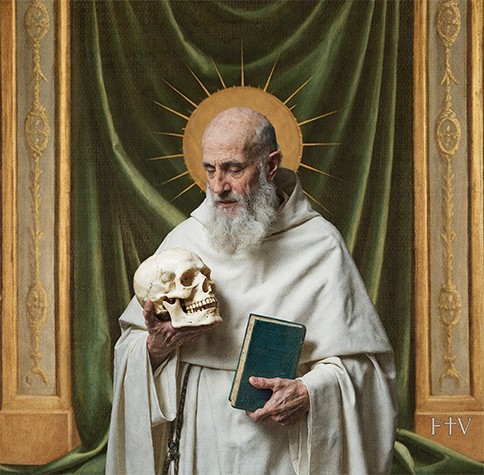
Born: c. 950, Ravenna, Italy
Died: 19 June 1027, Val-di-Castro, Fabriano
Traditional Feast Day: 7 February—Extended to the universal Church by Pope Clement VIII in 1595, using the date of the translation of his relics (1481) since 19 June was occupied by Saints Gervase and Protase.
Modern Roman Calendar Feast Day: 19 June (restored to date of death in 1969 calendar reform)
Canonized: Early local veneration; altar permitted over his tomb in 1032. Body found incorrupt in 1466. Feast extended to the universal Church by Pope Clement VIII in 1595.
Honoured for: Founding the Camaldolese Order, restoring monastic discipline and eremitical life, establishing the dual structure of hermitage and supporting monastery, persistent reform across Italy despite resistance.
Patron Of: Camaldolese Order, hermits and contemplatives.
Symbols in Art: Ladder (by which monks ascend to heaven), white Camaldolese habit, hermit cell, sometimes shown with crosier (as abbot) or pointing upward.
Invoked For: Contemplative life, perseverance in prayer and solitude, monastic reform, strength to resist worldly honour
and comfort.
Saint Romuald of Ravenna—Patronage & Symbols
Romualdus, Romualdo
No historical source records when Romuald was actually born. All proposed dates are calculations working backward from his death in 1027. 906/907 (traditional): Peter Damian's 11th-century biography claimed Romuald "lived 120 years." Since he died June 19, 1027, this yields birth in either 906 or 907 (depending on whether his birthday had passed).
This was accepted for centuries but creates impossible chronological conflicts with documented events in his life. 956 (Butler, 1750s): Alban Butler used Peter Damian's statement that Romuald was "about twenty" when he entered monastery. Butler dated the father's duel (which triggered Romuald's conversion) to around 976, making his birth around 956. 950-952 (modern consensus): Current scholarship assumes he lived approximately 75-77 years, which better fits the timeline of his known activities and monastic career.
While we know Romuald died in 1027, the surviving documentation doesn't allow us to determine his exact birth year—only to estimate it fell around 950.
What year was Saint Romuald born?
Saint Romuald is remembered as a restorer of monastic seriousness at the turn of the first millennium. The surviving narrative comes chiefly through early Camaldolese tradition as summarized in the Catholic Encyclopedia, which relies heavily on the Vita associated with St Peter Damian, and through later institutional memory preserved in Camaldolese sources. Romuald's mark on history is not one dramatic public act, but a repeated pattern: penitence, withdrawal, formation under severity, reform of monasteries, founding of hermit colonies, and a consistent refusal to be held by honour or office.
Remembering Saint Romuald
Romuald was born at Ravenna, Italy, about 950. The tradition attached to Peter Damian gives him an extreme lifespan (120 years), which would imply a much earlier birth date; the Catholic Encyclopedia records that this is rejected by most modern writers. The same sources present him as a nobleman of Ravenna, formed in a world where wealth and violence were normal conditions of life. A later Vatican-linked commentary identifies him more specifically with the noble Onesti line connected to Ravenna, which fits the broad social setting already assumed by the older summaries.
Birth and the Question of His Age

Romuald's conversion is fixed in the tradition to a single event. Around the age of twenty, he witnessed his father, Sergius, kill a man in a duel. Romuald fled in horror to the Benedictine abbey of Sant'Apollinare in Classe, near Ravenna, seeking penitence. This was not a temporary retreat. After hesitation, he entered the monastic life there.
The sources are unembellished about what followed. Romuald did not settle comfortably into the house. He found the observance insufficient, attempted to correct the less zealous, and met hostility. Permission was granted for him to leave and pursue a stricter solitary discipline. This early conflict is not presented as a quarrel of temperament; it functions as the first signal of his life's direction: he would not negotiate with laxity.
The Duel: The Rupture That Became Vocation
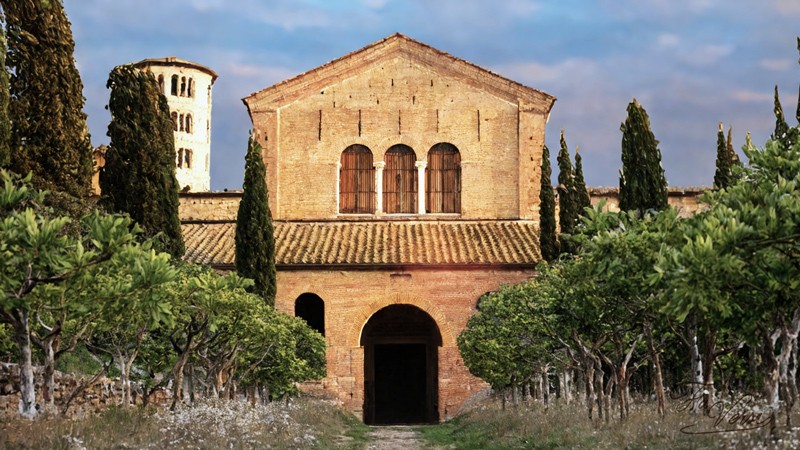
Sant'Apollinare in Classe, Ravenna—where Romuald entered monastic life after his father killed a man in a duel.
Leaving Classe, Romuald went toward the region of Venice and placed himself under the hermit Marinus. The sources emphasize the extraordinary severity of this training. A later liturgical commentary preserves a plain anecdote that illustrates what "severity" meant in practice: Romuald struggled with reading; Marinus struck him for mistakes; Romuald endured it, then asked only that the blows fall on the other side when one ear began to fail.
The tradition keeps this story because it is not romantic. It shows the intended stripping away of softness: obedience trained through endurance, and a novice who does not bargain for comfort.
Venice and Marinus: Formation Through Severity
This eremitical apprenticeship becomes linked to a major Venetian event. Pietro Orseolo I, Doge of Venice, burdened by remorse tied to political violence, abandoned his position and fled the world. The Catholic Encyclopedia relates that Orseolo went to the monastery of St Michael of Cuxa in Catalonia and took the Benedictine habit there. Romuald and Marinus established themselves as solitaries near the monastery, and Romuald remained in that setting for years, gathering men around the eremitical life. The Catholic Encyclopedia gives about five years for this period.
Cuxa matters because it reveals a durable trait of Romuald's approach: the hermit life is not framed as rebellion against the monastery. The hermitage stands near the monastery, sharper in austerity, but still within the same Benedictine world.
Pietro Orseolo and Cuxa: Enclosure Beside a Monastery
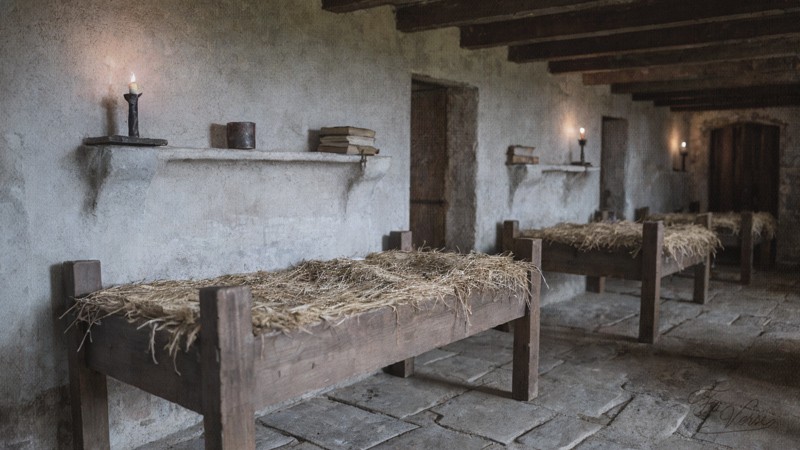
Romuald returned to Italy when his father Sergius—now a monk—fell into doubts about his vocation. The tradition records Romuald's response plainly: he subjected Sergius to severe discipline until his resolution was steadied. The purpose in the sources is not sentiment or spectacle. It is the insistence that a vow is not sustained by mood. This episode sets the tone for Romuald's later reform work: firmness aimed at stability.
Return to Italy: Sergius Tested and Steadied
After this return begins the long phase that makes Romuald difficult to summarize without flattening him. The Catholic Encyclopedia speaks of about thirty years of travel through Italy, founding monasteries and hermitages and reforming existing houses. The pattern repeats across places and decades:
he enters a community where discipline has weakened, he presses for stricter observance, he forms men for a more concentrated life, and then he withdraws—often abruptly—when resistance, honour, or institutional pressure threatens to dilute the purpose.
This is the central point: Romuald is repeatedly placed where influence is possible, yet he refuses to be captured by influence. His reforms are real, but he does not treat office as a prize, or permanence as a guarantee of success. The stability he seeks is interior and spiritual, not administrative.
Thirty Years of Movement: Reform Without Possession
Within this wandering period, certain places recur as resting-points. The Catholic Encyclopedia names Pereum as a favored resting-place. This is also the location where Romuald's reform work intersects with imperial patronage.
A Vatican-linked commentary, as preserved by Catholic Culture, states that Emperor Otto III appointed Romuald abbot at Sant'Apollinare in Classe and later at Pereum, pressing him to introduce austere reform. A related strand appears in Encyclopaedia Britannica's life of St Bruno of Querfurt, which states that Otto III founded a monastery at Pereum in 1001 for Bruno and Romuald.
These sources support a restrained conclusion: Romuald's reform life was not isolated. It intersected with the highest political power of his day, and Pereum became a significant site where imperial patronage tried to harness his austerity for institutional renewal. The consistent feature in Romuald's story remains his refusal to be held by honour. When authority threatened to turn into possession, he moved on.
Pereum and Otto III: Imperial Pressure on Monastic Reform
Around 1005 Romuald went to Val-di-Castro for about two years. When he left, the tradition records a foretelling: he would return and die there alone and unaided. He wandered Italy again and attempted to go to Hungary, but illness prevented it. The sources do not use the foretelling as a theatrical flourish. It functions as an anchor. The long motion of his life is drawn toward a fixed end, and the end will match the life—silence, solitude, no arranged witnesses.
Val-di-Castro: Foretelling and the Shape of His End
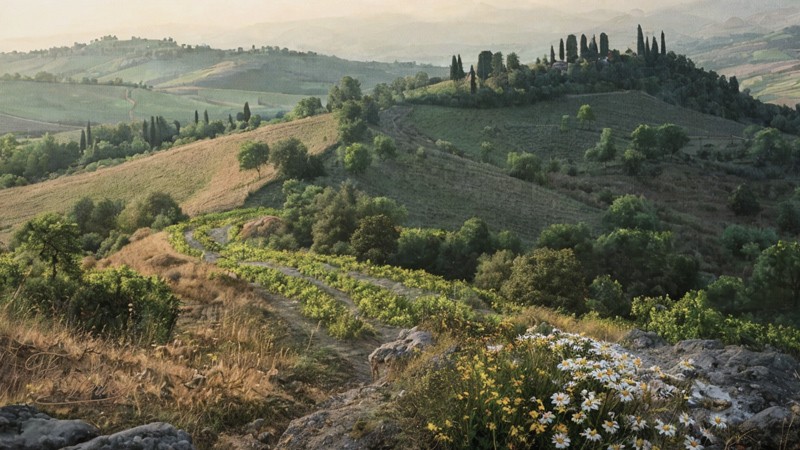
Romuald appeared at Vallombrosa in 1012 and soon after in the Diocese of Arezzo. This is the immediate prelude to the foundation that gives his movement its enduring form.
The Camaldolese sources explain what Camaldoli actually was in structure, not merely in legend: a hermitage of separate cells placed above, paired with a lower monastery meant to handle practical burdens, hospitality, and external necessities. The practical logic is explicit: if the hermits themselves must manage the outward business of life, the cell becomes symbolic rather than real. The supporting monastery exists to protect solitude.
Vallombrosa, Arezzo, and the Turning Toward Camaldoli
Romuald's most durable foundation is Camaldoli. The sources date it to 1012 and tie it to land in the Diocese of Arezzo. The founding tradition includes a benefactor figure connected to the name "Campus Maldoli," and it includes a vision motif of monks in white garments ascending to heaven, which the sources connect to the distinctive white habit in Camaldolese memory.
For biography, the essential fact is the resulting form:
separate cells for hermits, and below them a monastery (Fonte Buono / Fontebuono) to carry practical burdens so the hermits remain hermits in reality.
This is the core of Romuald's legacy: solitude held inside obedience, austerity protected by structure, and an eremitical life made sustainable across generations.
Camaldoli (1012): A Stable Form of Eremitical Life
Romuald's spiritual counsel is preserved in a short instruction commonly called the "Brief Rule," kept in the Camaldolese tradition. It is not a treatise and not a theory of monastic life. It is a narrow program of perseverance in solitude, rooted in Psalms and watchfulness over thought.
A line preserved in this tradition captures the tone without ornament: "Sit in your cell as in paradise." The text's emphasis is practical: remain, pray, return, resist inner wandering, and let perseverance do its slow work.
The Brief Rule: Cell, Psalms, and Watchfulness
After Camaldoli, the sources continue to trace Romuald's later movements: Monte Sitria is associated with him in 1013, and Bifolco in 1021. These names function in the record as evidence of continuity. Romuald's life does not settle into one establishment. It remains a chain of severe places—cells and communities formed around the same discipline.
Later Foundations and Last Years: Monte Sitria, Bifolco, and Return
Romuald returned to Val-di-Castro and died there on 19 June 1027. He died alone in his cell, in line with the earlier foretelling preserved in the tradition. The point is not drama. It is coherence. He does not die in a court or a chapter-house surrounded by honour. He dies where his life was aimed: the cell.
Death (1027): The End Matches the Life
The sources record miracles reported at Romuald's tomb and state that an altar was permitted over it in 1032, indicating early local recognition of his cult. The body was found incorrupt in 1466 and translated to Fabriano in 1481.
In 1595 Pope Clement VIII extended the feast to the whole Church and assigned it to 7 February, tied to the translation. A later liturgical explanation states the practical calendar reason: the date of his death, 19 June, was long occupied by the martyrs Gervase and Protase, so the universal observance used the translation day instead. In 1969 his feast was moved to 19 June in the reformed calendar.
Tomb, Translation, and the Church's Liturgical Memory
If Romuald's life is read only as a sequence of travels, it can seem scattered. The Camaldolese institutional memory shows what those travels produced: a form of life made durable. Camaldoli is not merely a place founded by a holy man; it is a structural answer to a practical problem. The hermit cannot survive as a hermit if he must constantly manage the world. The solution is not comfort, but order: hermit cells protected by a supporting monastery.
A common emblem in his iconography shows Romuald pointing to a ladder by which monks ascend. In the tradition, the image functions as a plain sign of his vocation and work: ascent through disciplined stability rather than public display.
Romuald's legacy, as the sources leave it, is therefore severe and plain:
penitence rather than aristocratic ease, discipline rather than negotiated observance, solitude without rebellion, reform without possession, and a lasting model
—Camaldoli—where silence is safeguarded by obedience and structure.
What Remains After the Story Ends
St. Romuald, "Brief Rule" (preserved in Camaldolese tradition)—Camaldolese.org
Primary Sources
Catholic Encyclopedia (New Advent), "St. Romuald"
Catholic Encyclopedia (New Advent), "Camaldolese"
CatholicCulture (L'Osservatore Romano commentary), "A 'Burning Bush' and 'Father' of Spiritual Wisdom"
CatholicCulture Liturgical Calendar, "St Romuald (June 19)"
Encyclopaedia Britannica, "Saint Bruno of Querfurt"
New Liturgical Movement, "The Feast of St Romuald"
Secondary Sources
Honour Saint Romuald with us in prayer and scripture. This video tribute invites you to meditate on his witness,
unite your petitions with his intercession, and remember his call to silence, conversion, and fidelity to Christ.
