

ENTER OUR VIDEOS
RECEIVE OUR WORK
Enter the full collection of our
tributes to Saints on YouTube.
Be notified quietly by email of our prayers,
reflections and new videos, free of charge.
Saint Ulrich of Augsburg
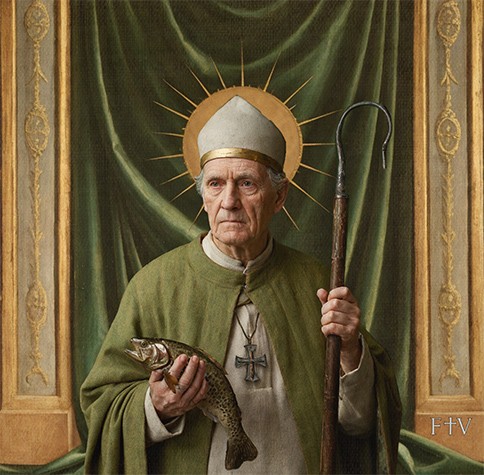
Saint Ulrich of Augsburg–Patronage & Symbols
Uodalricus, Ulric
Born: 889–890, Kyburg (in what is now Switzerland)
Died: 4 July 973, Augsburg (in what is now Germany)
Traditional Feast Day: 4 July—Honoured for steadfast faith during the Magyar invasions.
Modern Roman Calendar Feast Day: 4 July
Canonized: AD 993 by Pope John XV—the first saint formally canonized by a pope.
Patron Of: The city and diocese of Augsburg; co-patron of the diocese of Paderborn; travelers and wanderers; pregnant women in distress; fishermen; weavers; winemakers; winegrowers; the dying.
Symbols in Art: Fish (charity and Christ); crozier (shepherd of the flock); book.
Invoked For: Help in difficult birth; illness; fever; weakness; eye diseases; rabies; protection against plagues of rats and mice; weather and storms; safety in water dangers and floods; a peaceful, good, and blessed death; courage in the midst of trouble; relief from vertigo, dizziness, and faintness.

Was Saint Ulrich born in 890 or in 893?
Alban Butler's Lives of the Saints is widely respected and remains a standard devotional reference. Butler cites Gerhard's Vita sancti Uodalrici as printed in Mabillon, yet gives 893 as Ulrich's birth year. Gerhard's text does not state a birth year directly, but it records Ulrich's death in 973 at the age of 83—an age that implies a birth in 889 or 890. The discrepancy appears to stem from a numerical error in the citation process, producing 893, a date repeated in several later summaries.
What year did Saint Ulrich make his journey to Rome?
Some summaries give a single year for Ulrich's "journey to Rome," either 910 or the 950s, but the tradition actually preserves two separate Roman journeys, which is why the dating looks inconsistent. Gerhard's Vita describes Ulrich being in Rome early in his career (connected with Bishop Adalbero), and it also describes a later journey to Rome in which Ulrich visits the Apostles' shrines and obtains relics. Gerhard does not assign calendar years to either episode. Later reference summaries therefore supply dates: one Roman journey is placed in 910, and the relic-journey is placed in 952 or 953. In short: two trips, but not all sources mention both; the apparent discrepancy is usually an omission, not a contradiction.
Was Saint Ulrich canonized on 4 July 993, or on 31 January 993?
Some summaries attach the canonization to 4 July, Ulrich's feast day. The documentary record shows a Lateran synod on 31 January 993, followed by Pope John XV's confirming bull dated 3 February. In short: feast day is 4 July; the canonization act belongs to late January and early February 993 in the surviving John XV documentation.

Saint Ulrich is one of the clearest bishop-saints of the tenth century: a diocesan pastor, a disciplined administrator, and—above all—a public defender of Augsburg during the Magyar crisis. His cult formed early and rests on two firm supports: a near-contemporary Vita and the remembered defense of the city in 955. Later centuries layered additional stories and patronage claims onto his name; these belong to later tradition and are treated separately.
Remembering Saint Ulrich
Ulrich was born in 889–890 at Kyburg, near Zürich. He was the son of Count Hucpald and Thetbirga, and his family was connected with the dukes of Alamannia and with the imperial house of Otto the Great.
His education took shape at the monastic school of St Gall, where he is presented as formed under strict discipline and trained for real ecclesiastical responsibility rather than romantic withdrawal. At St Gall, St Wiborada is said to have foretold that Ulrich would one day be a bishop. From St Gall he entered diocesan service under Bishop Adalbero of Augsburg, described in the tradition as his uncle, and served within the bishop's household as chamberlain. This early cathedral experience matters for how he is remembered: Ulrich's sanctity in the sources is tied to steadiness within ordinary burdens—administration, repair, visitation, discipline, and public responsibility.
Origins and formation
Ulrich was ordained and consecrated Bishop of Augsburg on 28 December 923. He governed a diocese positioned between imperial politics, monastic reform movements, and recurrent external threat. The standard portrait of his episcopate is practical and concrete: building and restoring churches, visiting parishes, strengthening clerical conduct, caring for the sick and poor, and securing relics from Rome.
His personal discipline is preserved in tradition in concrete actions rather than vague praise. Butler records that Ulrich rose at three for Matins and Lauds, remained in church until None, then went to the hospital, where he comforted the sick and each day washed the feet of twelve poor people, giving a liberal alms to each.
Election and episcopal office (923–973)
Ulrich made journeys to Rome during his life. Gerhard's Vita describes these Roman journeys without assigning calendar years to the episodes, while later reference summaries place them in 910 and again in 952–953. In 954, Ulrich mediated between Otto I and his son Liudolf, meeting them at Illertissen and persuading Liudolf and Conrad of Lorraine to seek the king's pardon on 17 December 954.
A controversy attached to his name is the circulation of a letter presented as his, opposing priestly celibacy as an "unnecessary burden." Reference traditions treat this letter as a forgery and describe Ulrich as enforcing discipline in his clergy and in himself.
A late episode carries weight because it shows the Church judging even a celebrated bishop by canonical standards. After decades in office, Ulrich attempted to resign and transfer authority to a nephew. The act had imperial favor, but a synod ruled it uncanonical. Ulrich submitted, performed penance, and reconciliation was communicated to him at the end of his life.
Rome, discipline, and controversy
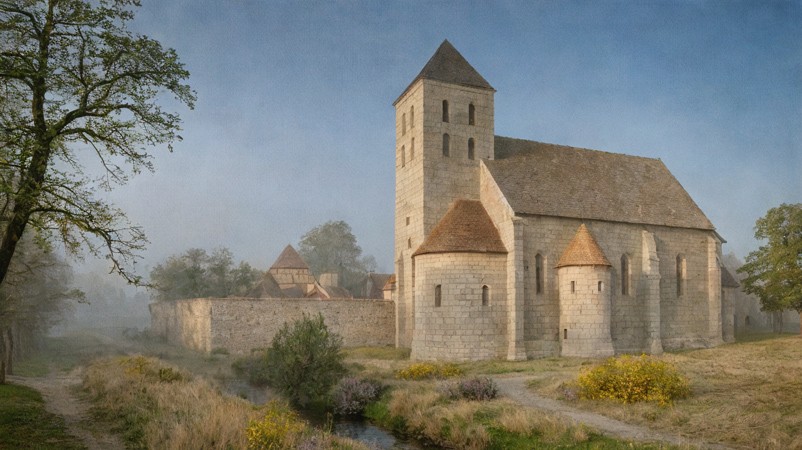
Ulrich's public fame crystallized in 955, when Magyar forces besieged Augsburg during their raids into Germany. The sources depict him inside the city during the crisis, organizing resistance and strengthening morale, and Augsburg holding out until imperial forces arrived. Later legend attempted to place him physically in the field battle. The sober line of tradition preserves the central fact: he was remembered as the bishop who did not flee when a city shook.
The siege stands in the same narrative arc as the decisive victory at the Battle of Lechfeld on 10 August 955, where the Magyar advance was broken. Ulrich's cult, in its earliest layer, is inseparable from this public defense: pastoral courage expressed through practical leadership in a concrete emergency. After 955, Otto I granted Augsburg the right to mint coins, a privilege tied in later memory to Ulrich's role in the crisis.
The Magyar threat, the siege of Augsburg, and Lechfeld (955)
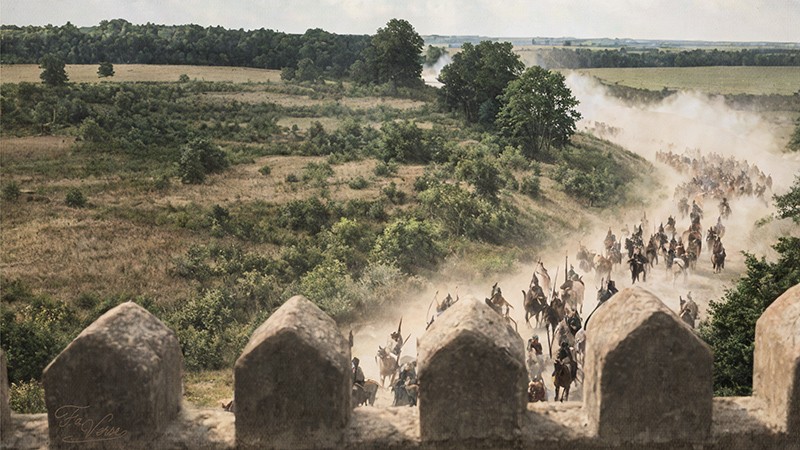
Magyar horsemen flood the fields beyond Augsburg
—a storm of fear and steel. While many fled in terror, Saint Ulrich stood firm in faith.
Ulrich died on 4 July 973 at Augsburg and was buried at the church of Saint Afra. Gerhard records that in his final hours ashes were laid in the form of a cross, holy water was applied, and the litany was sung around him.
Death and burial
The Vita, miracles, and the shape of his cult
The earliest full biography is the Vita sancti Uodalrici by Gerhard of Augsburg, written within a generation of Ulrich's death. Its structure includes both the narrative of his life and public acts and a collection of miracle reports attached to his memory. The second part of the Vita is a posthumous miracle dossier centered on his tomb. Gerhard records healings reported at Ulrich's tomb in the days after his burial. One modern catalog description of the text counts thirty miracle reports in its transmission.
Canonization and wider recognition (993)
Ulrich's canonization holds special historical weight because it stands as an early, documented act of papal confirmation of an established cult. The judgment belongs to a Lateran synod on 31 January 993, and Pope John XV issued the confirming bull dated 3 February 993.
This does not mean saints were absent before 993. It means Ulrich's case became a clear precedent for a more formal, centralized confirmation of cult.
His feast is kept on 4 July.
Iconography and later legend material
Ulrich's iconography commonly includes a fish, and later tradition explains it through a story of discipline under scrutiny: an attempt to accuse him of eating meat on a fast day is inverted when the meat is presented as fish.
Other later legendary elements cluster around pastoral objects: a chalice associated in tradition with aid to pregnant women, and a pastoral staff used in stories of healing, including bites from rabid dogs. These belong to later legend material rather than contemporary documentation.
Historical Veneration and Popular Devotion
Saint Ulrich's cult began immediately after his death in 973 and flourished continuously through the medieval and early modern periods. His canonization in 993 recognized an already thriving devotion centered on his tomb at the Church of Saint Afra in Augsburg, where pilgrims reported healings and miracles soon after his burial. Gerhard of Augsburg compiled thirty miracle stories by 993 to support the canonization cause, including cures of blindness, paralysis, and fever, and accounts of demoniacs freed at Ulrich's shrine.
A special liturgical Office for Saint Ulrich's feast was composed in the eleventh century, featuring chants that celebrated his virtues and proclaimed that "the devil alone groans, for at his tomb he continually loses his dominion"—a reference to the exorcisms reported at his grave. Medieval litanies of the saints in Southern Germany invoked "Sancte Udalrice, ora pro nobis," and by the twelfth century his intercession was sought across Bavaria for protection in war, healing in sickness, and relief from famine and plague.
Confraternities dedicated to Saint Ulrich spread his veneration locally. The weavers' guild of Augsburg established a Confraternity of Saint Ulrich and Saint Afra by the late Middle Ages, with statutes printed in 1697 listing indulgences for members who attended Mass on his feast day. In Wangen im Allgäu, a priests' confraternity of Saint Ulrich was founded in 1515 under his patronage, with statutes directing members to honour his feast and commend themselves to "his patronage for the defense of the faith and the averting of pestilence and war."
Pilgrims visiting his tomb obtained blessed objects, most notably the Ulrichskreuz—small crosses modeled after the relic of the True Cross that Ulrich carried into the Battle of Lechfeld in 955. By the seventeenth century, these crosses bearing the inscription CRUX VICTORIALIS S. UDALRICI were distributed as sacramentals for protection from misfortune. Pilgrims also collected holy water from "Ulrich's springs" (Ulrichs-Brünnlein) in Swabia, believed to cure eye diseases, and received blessed wine known as Ulrich-Minne for health and unity.
An eighteenth-century German litany published in Augsburg in 1830 invoked Ulrich with honorific titles reflecting his enduring patronages: "Schild der Stadt" (shield of the city), "Arzt der Kranken" (physician of the sick), and "Tröster der Bedrängten" (comforter of the afflicted). Regional traditions attributed wide-ranging intercessions to Ulrich: as protector of cities and armies, healer of eye diseases, guardian against vermin and plague through blessed earth scattered on fields, master of weather and storms, and patron of a holy death. Pilgrimage records from 1730 describe crowds traveling from Hungary, Moravia, and Bohemia to Ulrich's springs, taking his water home as a remedy for ailments.
Primary Historical Sources
Gerhard of Augsburg, Vita sancti Uodalrici (written within a generation of Ulrich's death; published in Mabillon's Acta Sanctorum Ordinis S. Benedicti, Saeculum V, 1685, pages 419-460)
Liturgical Office of Saint Ulrich (11th century, attributed to Abbot Berno of Reichenau)
Statuten der Ulrichs-Priesterbruderschaft Wangen (Latin statutes, 1515/1540; Pfarrarchiv St. Martin Wangen)
Litaney und Gesang zu Ehren des Heiligen Bischofs und augsburgischen Patrons Udalrikus (Augsburg: Bruggay, 1830)
Secondary / Reference Sources
Catholic Encyclopedia (New Advent): "St. Ulrich", "Augsburg"
Alban Butler, Lives of the Saints, July 4: "St. Ulrich"
Encyclopaedia Britannica: "Saint Ulrich"
Catholic News Agency: "St. Ulrich of Augsburg"
Encyclopedia.com: "Ulric of Augsburg, St."
Geschichtsquellen.de: Vita sancti Uodalrici (catalog entry)
christianiconography.info: iconographic attributes
Ökumenisches Heiligenlexikon: "Ulrich von Augsburg"
Rottenburger Jahrbuch für Kirchengeschichte: "500 Jahre Ulrichspriesterbruderschaft in Wangen im Allgäu" (2015)
Sobottapedia: "Ulrichsbründl – Neusiedl an der Zaya" (pilgrimage site documentation)
Honour Saint Ulrich with us in prayer and scripture.
This video tribute invites you to meditate on his witness,
unite your petitions with his intercession, and remember his steadfast faith in Christ.
