ENTER OUR VIDEOS
RECEIVE OUR WORK
Enter our full collection of
sacred video meditations on YouTube.
Be notified quietly by email of
our reflections and new videos, free of charge.
Let There Be Light: Medieval Candle-Making
“For with thee is the fountain of life;
in thy light do we see light.”
—Psalm 36:9 (RSVCE)
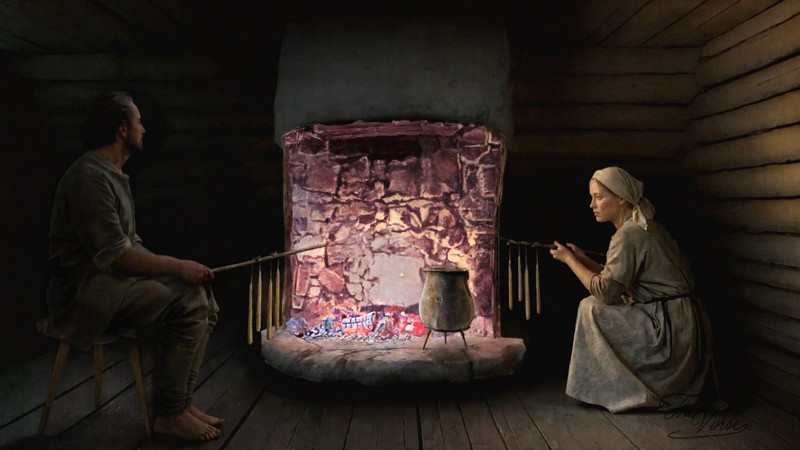
—the winter work of preparing medieval Advent candles to be offered to their parish.
Light after dark was precious in the medieval world. Most households relied on rushlights and tallow candles, made from rendered animal fat, or rushlights soaked in grease. These gave off smoke, an unpleasant smell, and an uneven flame. Beeswax candles burned differently. They were clean, steady, and carried the faint sweetness of honey. But they were expensive, and their use was largely reserved for the Church and the wealthy, especially outside towns and monastic estates.
From the earliest centuries, the Church favored beeswax for the altar. The reason was symbolic. Medieval liturgical writers taught that beeswax represented the pure flesh of Christ, born of the Virgin Mary. The wick enclosed within the wax symbolized His soul, and the flame His divinity. Beeswax was seen as a virgin substance, produced by bees without corruption (a belief repeated in medieval bestiaries), just as Christ's body was born without sin. These ideas shaped the entire understanding of Catholic altar candles and the symbolism of beeswax in the Church.
Tallow, by contrast, came from slaughtered animals. It smelled of fat and death. When burned, it gave off acrid smoke and dripped unevenly. The Church did not formally prohibit tallow candles in the Middle Ages—no universal canon banned them outright—but the custom was clear: beeswax was the liturgical ideal for the altar, and tallow was tolerated for other church lighting when necessity required.
In places of real poverty, priests sometimes used tallow candles at Mass when beeswax could not be obtained, especially in remote settings where medieval church candles were difficult to procure.
This changed in the nineteenth and early twentieth centuries. The Church finally codified what earlier centuries had treated as custom: altar candles were to be made of beeswax, not animal fat. What had once been practice became written law, and the old exemptions of poverty gradually disappeared.
Why Beeswax Candles Were Required for the Catholic Mass
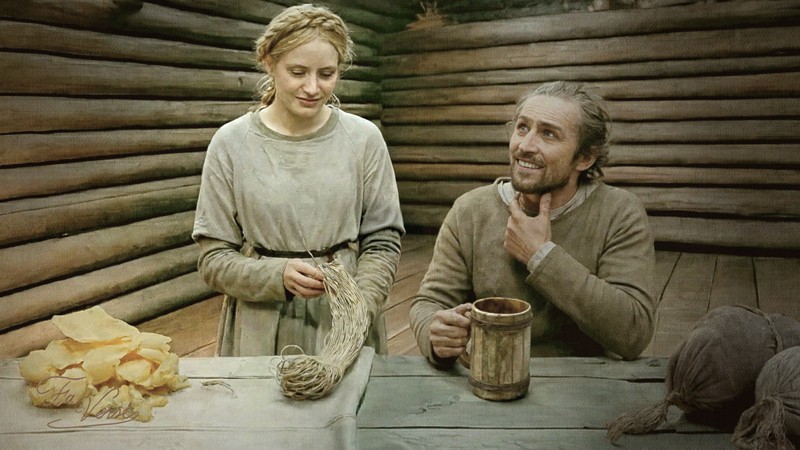
A medieval household preparing clean beeswax and hand-twisted wicks
—the first steps in shaping Advent candles for the parish during the quiet weeks of winter.
Beeswax was a byproduct of honey production. After the honey was extracted from the comb, the wax was purified by boiling—often in seawater or salted water—and skimming off impurities. This was the normal method of medieval wax rendering, producing a clean, workable material.
The simplest and most common method of medieval candle making was dipping. A wick of twisted hemp or flax was suspended from a rod and repeatedly dipped into a pot of melted wax. Each dip added a thin layer, which hardened as it cooled. The process was repeated dozens of times until the candle reached the desired thickness. It was slow work, requiring patience and attention to keep the wax at the right temperature: warm enough to coat the wick, but not so hot that it scorched.
Some candles were made by rolling soft wax around a wick, but this method was less common in household settings. Candle molds appeared in Europe in the late medieval period, but they were used primarily by professional chandlers and monasteries. A rural household would not have owned such equipment. Dipping was the practical method for domestic candle-making in the Middle Ages.
The tools were simple: a pot or cauldron to melt the wax, a rod or frame to hold the wicks, and a pricket candlestick (a spike on which the finished candle could be impaled to dry). This plain hardware forms much of what we now call medieval household lighting. The work was often done outdoors to avoid filling the house with wax fumes, or near the hearth if the weather did not allow for it.
Medieval Candle-Making
Most beeswax produced in medieval Europe came from monasteries, noble estates, and commercial beekeepers in towns—not from ordinary households. Beekeeping required land, knowledge, and resources that were beyond the reach of most peasants. Monasteries often kept apiaries and rendered their own wax, producing candles for their chapels and selling the surplus. Well-off landowners might do the same. The scale and labour involved made beeswax part of the broader system of medieval beeswax production.
In rare cases, a prosperous miller or farmer with access to hives might render a small amount of wax, but the majority of it would be sold to the church or given as an offering. A few tapers might be kept for feast days or special occasions, but daily lighting in most homes relied on tallow or rushlights. For villagers, beeswax candles were a luxury—an item one might see at Mass rather than on the household table. This contrast mirrors the broader divide between medieval lighting in elite estates and in peasant cottages.
In wealthier households—manor houses, merchant families, urban elites—beeswax candles lit the table at night and burned in wall sconces. These were the settings where clean, bright beeswax candles were both affordable and expected. For most people, they remained something encountered primarily at Mass.
Beekeeping and Beeswax Production in the Middle Ages
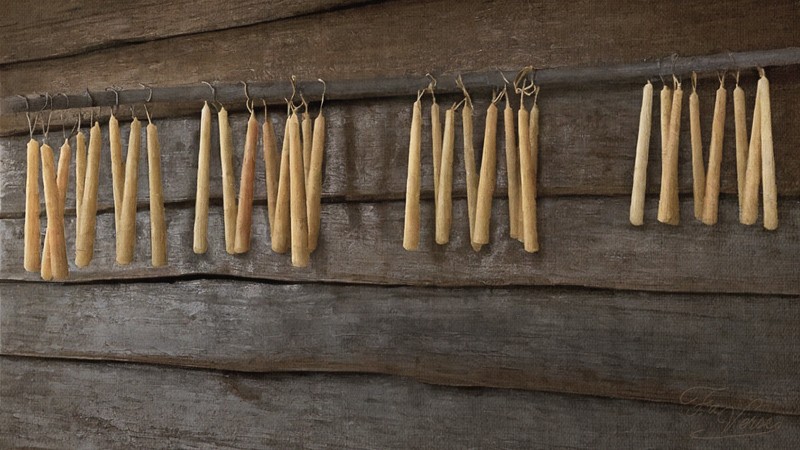
Freshly dipped beeswax tapers drying on wooden beams
—Advent candles made at home before being carried to the parish.
The candles themselves were plain. Household candles were usually small, hand-dipped tapers. Altar candles were longer and made to burn through the length of the liturgy. Slender tapers, golden in color. They were rarely decorated or elaborately shaped. Their value lay not in ornament but in the purity of their liturgical beeswax and the quality of their light.
Many would be offered to the parish—the wax rendered from the hive, purified by fire, shaped by hand. Some would burn at home, but others would become church candles that sustained the liturgy through the long nights of Advent and the vigil of Easter.
The work is humble.
The light is sacred.
Medieval Liturgical Candles
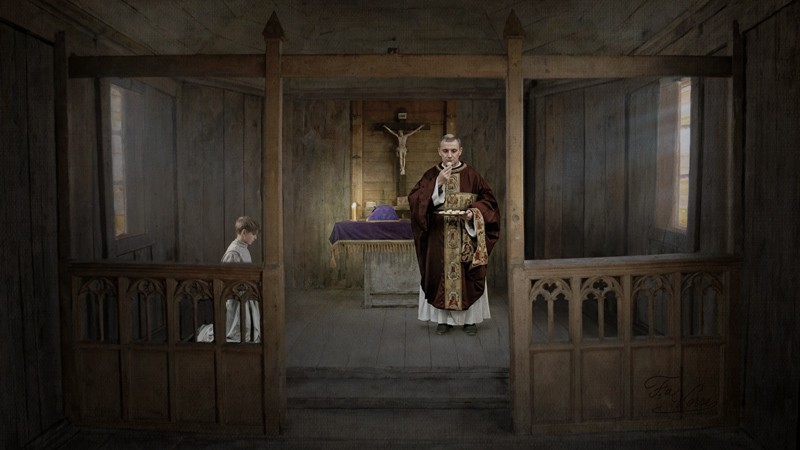
At the altar of a small medieval wooden church, the priest raises the Host and proclaims Ecce Agnus Dei.
The beeswax candles burn steadily beside him, their quiet flame joining the solemn moment of the Eucharist.
From our Advent series: a quiet meditation on waiting, prayer,
and the coming of the Lord, woven through Scripture and sacred stillness.