
ENTER OUR VIDEOS
RECEIVE OUR WORK
Enter our full collection of
sacred video meditations on YouTube.
Be notified quietly by email of
our reflections and new videos, free of charge.
Before the Chimney:
How Medieval Houses Lived With Smoke
“And Mount Sinai was wrapped in smoke,
because the LORD descended upon it in fire;
and the smoke of it went up like the smoke of a kiln.”
—Psalm 36:9 (RSVCE)
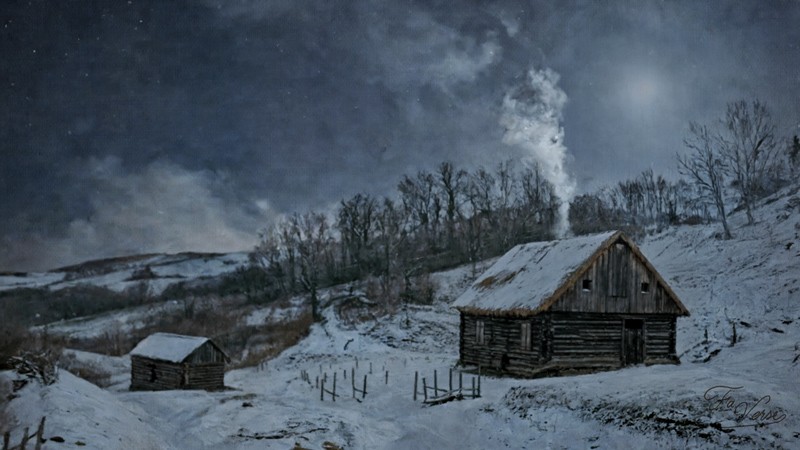
a feature that marked better-off farming families.
For centuries, European households lived with smoke. The fire burned on a clay hearth in the center of the room, and its fumes rose into the rafters, drifting out through thatch or a louvered opening in the roof. Families worked, ate, and slept in that haze. It was the cost of warmth. The central hearth provided light and heat, but it also blackened the beams, irritated lungs, and kept the interior perpetually dim. This was not primitive ignorance. It was the practical reality of heating a wooden house with an open flame.
The hearth remained in the middle of the floor because moving it seemed impossible. A fire against the wall risked setting the structure ablaze. High ceilings helped disperse smoke and keep sparks away from thatch, but much of the heat escaped with the fumes. In peasant cottages, there was no alternative. In great halls, the same arrangement prevailed, though on a larger scale. Whether in a one-room hut or a Norman baron's timber hall, the pattern held: fire in the center, smoke overhead, and a band of clearer air near the floor where people lived and worked.
By the High Middle Ages, builders began experimenting. The breakthrough was simple: move the fire to the wall and capture the smoke before it spread. A wooden frame, plastered thick with clay, hung above the hearth like an inverted funnel. This smoke-hood directed fumes upward toward a roof vent, creating a draft that pulled smoke out of the living space. It was not perfect. Some smoke still leaked into the room, and the hood itself required careful maintenance. But it worked well enough to spread across Europe.
The smoke-hood reshaped the household. With the fire anchored to the wall, the center of the room opened up. Floors no longer needed to accommodate a ring of stones. Rafters stayed clearer. The air improved, though winter still brought its familiar haze. In many homes, the hood did not vent directly through the roof. Instead, it fed smoke into a loft or attic space above the main room—a smoke chamber where fumes dispersed slowly before seeping out through eaves and gaps in the thatch. This arrangement kept the worst of the smoke out of the living area while avoiding the need to puncture the roof with a full chimney stack.
Later builders extended the vent all the way through the roof, creating a rudimentary chimney. These early chimneys were fragile. Built of timber and wattle daubed with clay, they had to be rebuilt often. Fire was always a risk. As the technology spread, so did regulations. By the fifteenth century, some towns outlawed wooden chimneys entirely, requiring brick or stone. The shift was gradual, uneven, and driven as much by fire safety as by comfort.
The Smoke-Hood
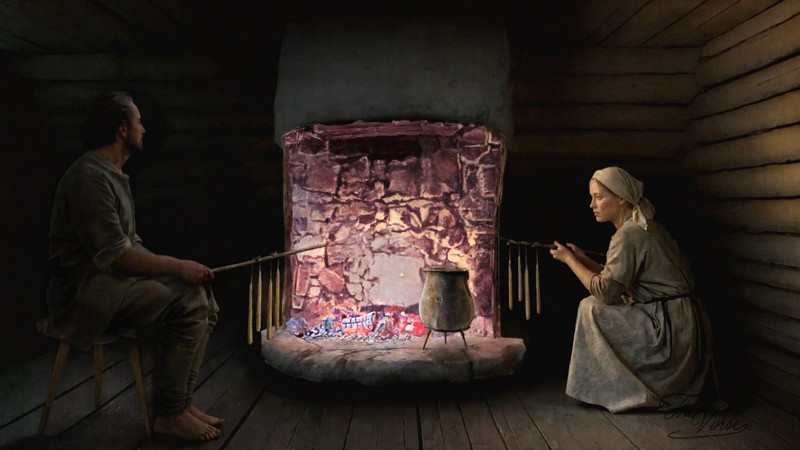
A medieval household preparing candles by the hearth beneath a clay-plastered smoke-hood
By the twelfth century, stone castles and manor houses in France and England were being built with true chimneys: vertical masonry flues that channeled smoke from a wall fireplace up through the roof and out into open air. The hearth was no longer a fire on the floor but a built structure set into the wall, beneath a hooded opening that connected to a tapered flue. Inside, the room stayed cleaner. Ceilings could be lower. Multiple floors became possible, each with its own fireplace venting through a common stack.
This was a luxury feature at first, confined to castles and the homes of wealthy merchants. English royal records from the thirteenth century show chimney installations in royal chambers. By the fourteenth century, urban houses in Bruges, Paris, and London were being built with fireplaces in individual rooms. The social effects were profound. Nobles began to dine in private chambers instead of the great hall. Families withdrew to heated rooms by the hearth, abandoning the communal space that had defined medieval domestic life. Privacy, once rare, became desirable. The house segmented. Rooms multiplied.
The Masonry Chimney in Castles and Towns
In Central and Eastern Europe, a parallel development appeared: the masonry stove. German-speaking regions are credited with inventing the tiled stove (Kachelofen) in the mid-thirteenth century. Unlike an open fireplace, the tiled stove was an enclosed structure. Wood burned in a chamber lined with ceramic tiles or pots. The thick ceramic walls absorbed heat and radiated it into the room long after the fire burned out. These stoves were far more efficient than open fireplaces, holding warmth through the night and requiring less fuel.
Early stoves did not always require chimneys. Many were designed with a two-room system: the firebox opened into a separate kitchen area where smoke accumulated, while the stove body protruded into the adjacent living room. The smoke stayed in the kitchen side, which often had a vent or simply a smoke hole, while the main room enjoyed clean radiant heat. Over time, stoves were integrated with chimneys or equipped with simple hoods that vented smoke into lofts. By the fifteenth century, many Central European homes combined both technologies: a fireplace for cooking, a stove for heating.
Tiled stoves spread rapidly in towns. Prosperous burghers in cities across Germany, Bohemia, Poland, and Hungary installed ornate stoves covered in glazed tiles depicting saints, heraldry, or elaborate patterns. These were status symbols. Archaeologists have found thousands of stove tiles from fourteenth- and fifteenth-century urban contexts, attesting to their popularity. In castles and affluent homes, a well-built tiled stove could heat a sitting room cleanly and efficiently, creating a space separate from the smoky kitchen.
But tiled stoves remained largely urban. They required skilled craftsmen to build, ceramic tiles to line, and masonry expertise to integrate. In the countryside, peasants continued to rely on simpler arrangements: open hearths, smoke-hoods, or basic clay ovens that filled the room with smoke during firing but provided radiant heat afterward. The tiled stove was a townsman's luxury, not a feature of rural cottages.
The Tiled Stove in Central Europe
Peasants and rural people had to wait much longer. In the countryside of Central and Eastern Europe, change came slowly. Through the fourteenth and into the fifteenth century, many peasants still lived in one-room cottages with no chimney at all. The fire burned on a clay hearth in the center or corner of the room, and smoke drifted out through thatch or a simple roof opening. The interior walls and rafters blackened with soot. This was the pattern that had prevailed for centuries.
But better-off farmers began to build partial chimneys. These were external structures: wooden frames plastered with clay, built on the outside wall and rising above the roofline. Inside, a wide hearth opened beneath a hood large enough to stand in. The smoke funneled up and out, keeping the room clearer than an open fire ever could. The chimney itself was simple—timber and wattle thickly coated in clay to resist fire. At the base, where heat was greatest, some builders lined the throat with fieldstone or brick. A small bread oven might be built into the side, its domed chamber accessible from inside or out.
The chimney was placed along one of the long walls, roughly central, jutting out from the thatched roof like a boxy tower. It was not decorative. It was functional, built to last, and rebuilt when it failed. Daily life revolved around this hearth. In winter, the family gathered near the wall to cook and stay warm. A cauldron hung from an iron hook under the hood. Meat turned on a spit. The smoke rising through the chimney also dried the thatch and preserved meat hung in the rafters. At night, the fire was banked with ashes to keep an ember alive until morning.
The chimney marked a household's investment in permanence. It set a farm apart as wealthier, more stable, better built. But it remained a minority feature in rural Europe until the sixteenth century. Most peasant cottages kept the open hearth in the center of the floor well into the early modern period.
The Peasant Chimney
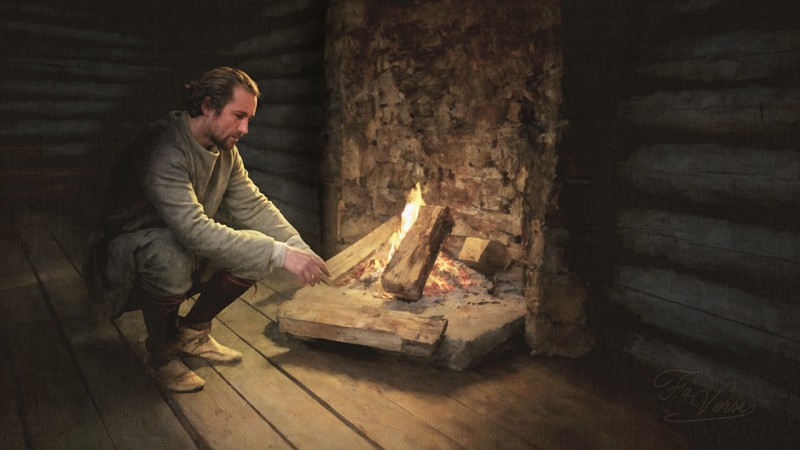
A medieval man tending the fire beneath a smoke-hood
—the breakthrough that moved the hearth to the wall and captured smoke before it filled the room.
By the sixteenth century, chimneys were no longer rare. Even modest cottages in England and the Netherlands had small brick stacks rising from their roofs. The open hearth in the center of the floor had become a relic. Towns mandated chimneys for fire safety. Hearth taxes appeared, using the number of chimneys as a measure of household wealth.
The shift was uneven. Inremote areas of Northern and Eastern Europe,
smoke rooms persisted into the nineteenth century. But across most of Europe, the chimney had become standard. It reshaped domestic architecture, enabling multi-story homes, private heated rooms, and cleaner air. It altered family life, encouraging smaller gatherings and withdrawal from the communal hall. It changed how people built, lived, and thought about the space they inhabited.
The chimney did not announce itself. It was a modest innovation, a masonry flue that carried smoke out of the house. But it transformed the medieval home as thoroughly as any technological advance of the age. It allowed the house to breathe.
The Spread of Chimneys
From our Advent series: a quiet meditation on waiting, prayer,
and the coming of the Lord, woven through Scripture and sacred stillness.