In Darkness and Light

Medieval life lived between hardship and faith, where darkness and light endure together.
The Faith and Verse In Darkness and Light collection presents scenes of rural medieval life within a historically grounded fictional setting in early fifteenth-century Silesia.
It is not a collection of interchangeable medieval backgrounds, but an inhabited world with recurring families, craftsmen, clergy, labourers, travellers, homes, roads, fields, woodland, parish life, and remembered events. The same people return across separate scenes, carrying with them their relationships, occupations, possessions, losses, duties, and small histories.
The world does not tell one continuous story. Each image stands on its own, yet together they gradually reveal a larger life: children growing within households, work repeated through the seasons, old men remembering war, travellers passing through, families preparing for winter, the church holding the centre, and the ordinary rhythm of labour, prayer, hunger, hospitality, grief, and feast.
The setting remains rooted in the material and social world of early fifteenth-century Silesia.
View our other collections here.
Photograph of a printed Faith and Verse 5×7 card, produced on double-thick matte stock.
The In Darkness and Light cards use the same physical format, paper, finish, and writable reverse.
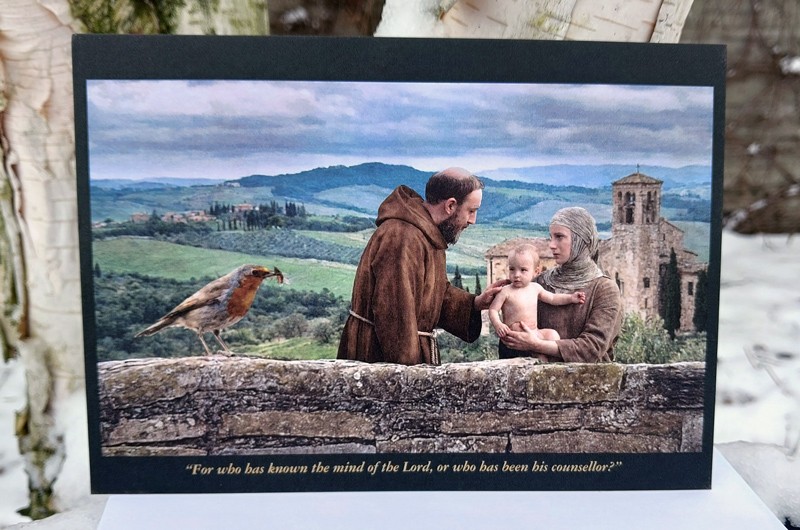


New scenes will be added slowly, as the village and its people continue to take form.
What These Cards Are
A greeting card is a simple object.The In Darkness and Light cards preserve small moments from an imagined rural Silesian community around the year 1410. A mother and daughter gather what they can before winter deepens. A family shares the warmth of a hearth. Bread is prepared, animals tended, journeys made, children taught, the dead remembered, and the seasons received as they come.
The people shown here are not anonymous figures assembled anew for every image. They belong to recurring households and places. The same faces return. Children remain children of particular parents. Craftsmen return to the same work. Roads lead back to familiar buildings. Across separate scenes, fragments of ordinary lives begin to accumulate.
Printing and Format
Faith and Verse In Darkness and Light cards are printed greeting cards, designed by Faith and Verse and printed, handled, and fulfilled through Zazzle. The artwork, composition, and presentation are entirely ours; Zazzle is used solely for manufacturing and delivery.
Each card measures 5×7 inches and comes with an envelope. The reverse is left largely open for a personal message.
The cards are printed on signature double-thick matte stock, chosen for its weight, stiffness, and absence of modern gloss. They are intended to feel like small physical objects—something to send, keep, place beside a book, or leave standing quietly on a shelf.
The Medieval Silesian World
The collection is rooted in rural Silesia at the beginning of the fifteenth century.
Its world is built from the material conditions of ordinary life: timber houses, clay floors, wool and linen clothing, iron tools, woven baskets, open fields, woodland, livestock, smoke, mud, frost, firelight, hand labour, parish worship and the long movement of the agricultural year.
Historical evidence informs these details without turning the images into diagrams or demonstrations.
A house should feel inhabited before it feels educational. A winter road should first feel cold. A hearth should give warmth before it becomes an example of medieval construction. Clothing, tools and architecture matter because real human lives were lived among them.
The purpose is not to display research. It is to give the past weight.
Darkness and Light
The Middle Ages are neither romanticized nor condemned here.
Darkness is present: hunger, sickness, fatigue, danger, winter and death belong to the world these people inhabit. A failed harvest matters. Cold enters through timber walls. Food must be gathered, stored and stretched through the months ahead. Work is repetitive because survival depends upon repetition.
Yet light also endures.
A mother teaches her daughter. A father tends the fire. Food is shared. The bell calls people to Mass. The Cross is traced over bread. The dead lie close to the church. Advent comes with winter; Christmas follows waiting. Faith does not arrive from outside the ordinary world to decorate it.
It is already there.
The collection does not ask the medieval world to be comfortable before it can be meaningful.
Scripture and Ordinary Life
Some In Darkness and Light cards carry a verse of Scripture.
The verse does not turn the people in the image into Biblical characters, nor does it force every ordinary action into allegory. It accompanies the scene.
A child learning beside her mother may stand beneath words asking the Lord to teach His paths. A traveller may carry a verse about pilgrimage or trust. Winter may accompany words of waiting. Harvest, bread, grief, work, rest and home may find natural echoes in Scripture without ceasing to be what they visibly are.
The image remains a medieval moment.
The words open another depth within it.
A World Remembered Through Ordinary Things
In Darkness and Light does not reconstruct the Middle Ages in order to admire them.
It recollects a way of living in which existence was local, inherited and bound closely to land, household, season and God.
Most lives left no portrait. Most houses disappeared. Most hands that planted, spun, cut wood, carried water, buried parents and raised children are entirely unknown to us.
Yet ordinary life was where almost all human history actually happened.
These images return to that scale.
The aim is neither nostalgia nor spectacle, but presence—to stand for a moment beside people doing what had to be done, in cold and warmth, darkness and light, while the year turned around them.