ENTER OUR VIDEOS
RECEIVE OUR WORK
Enter our full collection of
sacred video meditations on YouTube.
Be notified quietly by email of
our reflections and new videos, free of charge.
The Celtic Tonsure:
A Question of Uniformity
“They shall not shave their heads
or let their locks grow long;
they shall only trim the hair of their heads.”
—Ezekiel 44:20 (RSVCE)
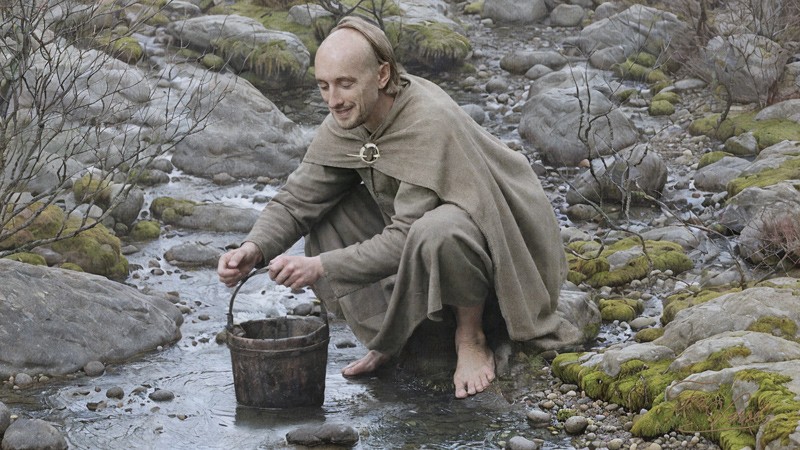
and accepted traditionally to represent the hairstyle of early Irish clergy.
It's possible that some Irish clergy wore a hairstyle similar to this.
In the year 664, representatives of the Roman and Celtic churches gathered at the Synod of Whitby to settle two major disputes:
when to celebrate Easter, and how monks should cut their hair.
To modern ears, this might sound absurd. But in seventh-century Britain, the tonsure—the distinctive hairstyle worn by clergy and monks—was a visible declaration of ecclesiastical allegiance. Roman monks wore the corona, a circular ring of hair surrounding a bald crown—a style that emerged in the sixth century, replacing the earlier Christian practice of shaving the entire head. Celtic monks wore something else.
Over 1,300 years later, scholars still debate about what that "something else" looked like.
The Roman side won at Whitby. The "Irish tonsure" was condemned—that is, the Roman corona was established as standard, and any hairstyle that deviated from it fell under condemnation as "the Irish tonsure." The most detailed surviving description comes from a letter written in 710 AD by Abbot Ceolfrid of Wearmouth-Jarrow to King Nechtan of the Picts, describing the hairstyle worn by Celtic clergy. Other sources mention the Celtic tonsure briefly—Bede refers to it as capita sine corona (heads without crown), a seventh-century chronicle (whose attribution to sixth-century Gildas is debated) claims it extended "from ear to ear"—but none provide the detail Ceolfrid's letter does.
From that letter, three major scholarly theories have emerged. Each attempts to reconstruct the exact form. Each contradicts the others. The debate continues because the sources are sparse, hostile, and open to interpretation.
This essay argues for a perspective implied by the evidence but rarely stated explicitly: perhaps there was no single 'Celtic tonsure' to reconstruct.
The oldest interpretation dates to the seventeenth century: Celtic monks shaved the front of their heads in a semicircular shape, ear to ear, leaving short hair at the back. This "traditional view" dominated textbooks for centuries.
In 2003, Daniel McCarthy of Trinity College Dublin proposed something different: the Celtic tonsure was triangular, shaped like the Greek letter delta, based on visual analysis of figures in the Book of Kells.
In 2007, James McIlwain of Brown University argued both previous theories misread the sources. He claimed Celtic monks shaved their entire heads except for a tuft of hair at the front.
All three theories rely primarily on Ceolfrid's letter. All three interpret it differently. The debate remains unresolved.
The Three Theories
Ceolfrid's 710 letter describes the Celtic tonsure as appearing to have "the form of a crown" when viewed from the front, but being "cut short" in back. That description
—vague and polemical—has been the subject of interpretation for three centuries.
The letter was written by a Roman partisan advocating for a Pictish king to abandon Celtic practices. It was not neutral description but religious polemic. Throughout the letter, Ceolfrid associates the Celtic tonsure with Simon Magus, the sorcerer from Acts who tried to buy spiritual power. The language is imprecise. "Cut short" could mean many things. Ceolfrid was not writing instructions—he was condemning something he considered heretical.
Other sources are similarly hostile and vague. Bede repeatedly uses the phrase capita sine corona—heads without crown—but provides no detailed description of what the hair actually looked like. A seventh-century chronicle claims the Celtic tonsure extended "from ear to ear" and originated with Simon Magus. These sources agree on what the Celtic tonsure was not (the Roman crown), but none specify precisely what it was.
The sources that survive were written by opponents describing practices they considered wrong. Their goal was condemnation, not documentation.
Polemical Witnesses and Vague Language
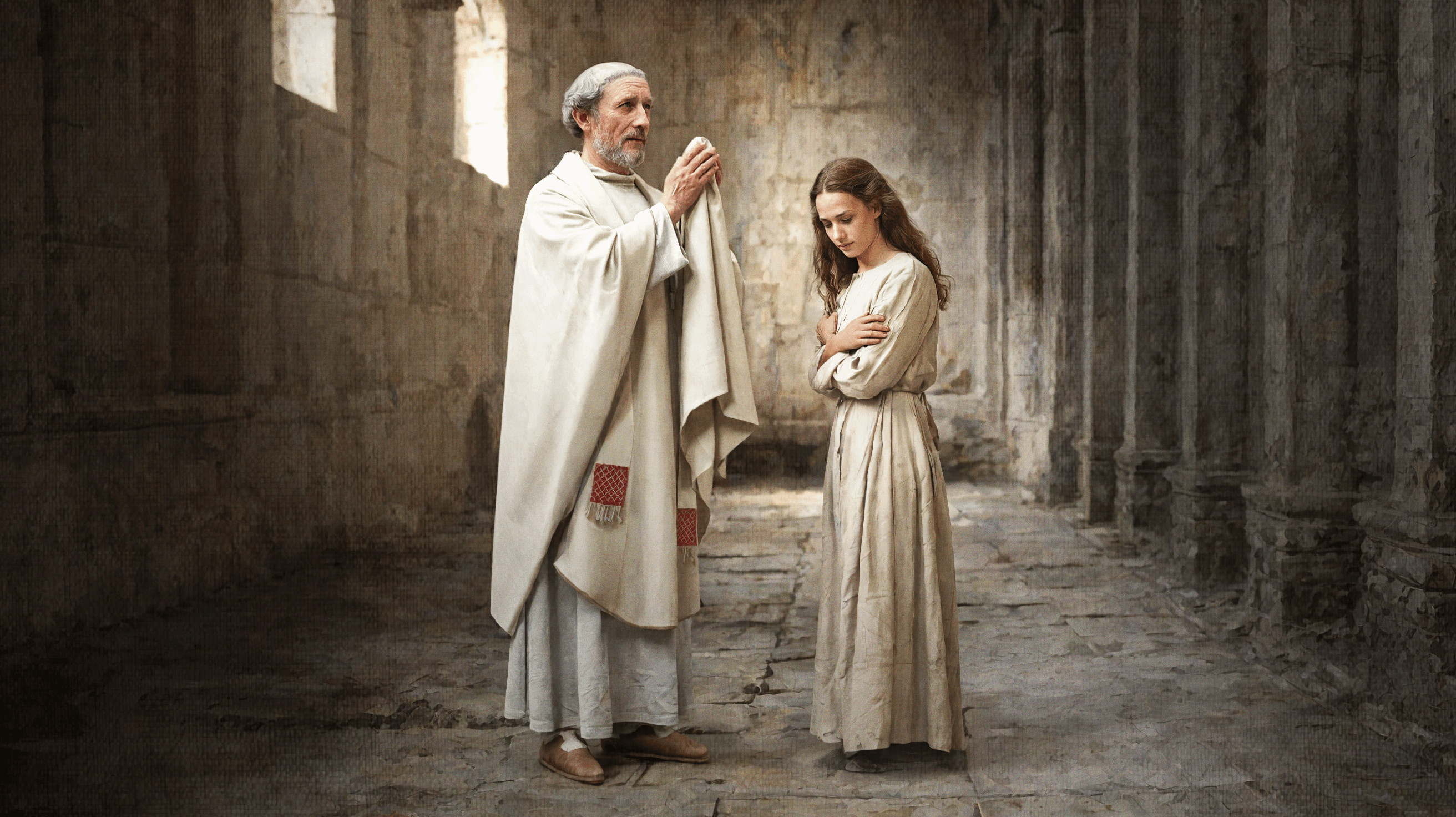
Saint Amandus of Maastricht consecrating Saint Aldegundis, c. 657 AD,
showing the Continental tonsure that had taken its standardised form by this period.
Early Celtic Christianity is extensively documented.
We have Irish penitentials listing punishments for every imaginable monastic offence. We have monastic rules specifying what monks should eat, wear, and how many times they should pray. We have saints' lives, annals, legal texts, liturgical manuscripts, and illuminated works like the Book of Kells.
Irish legal texts—the Brehon laws—specified what colour cows counted as proper payment for debts. They detailed exact penances for specific sins. They included rules for baking bread, brewing ale, and keeping bees.
Not a single Celtic source gives clear instructions for cutting the Celtic tonsure.
If there was one standardised "Celtic tonsure" that all Irish, Welsh, Pictish, and British monks wore—if it was important enough to fight about at Whitby—the Celts would have written it down. They wrote down everything else. If there was a standard way to cut the Celtic tonsure, we should have instructions in monastic rules, descriptions in saints' lives, or references in penitentials to improper cutting.
We have none of this.
Some scholars point to figures in the Book of Kells as evidence for specific tonsure forms. Yet examination of the manuscript reveals highly stylized figures with full hair, baldness, or ambiguous coloring that could represent many things. Even where scholars identify possible tonsures, the forms vary within the same illumination
—suggesting diversity rather than uniformity. Clear, consistent depictions of a single distinctive haircut are absent.
The Silence of Celtic Sources
Celtic Christianity was marked by regional variation, not uniformity.
The Easter Controversy: In 630 AD, the Irish church held a synod at Mag Léna to resolve disputes over calculating Easter. The result was division. Southern Irish churches accepted Roman calculations. Northern churches and Iona refused. Even after Whitby settled the matter in 664, Iona didn't conform until 716—fifty-two years of continued resistance. Multiple calculation methods for Christianity's most important feast coexisted for centuries.
If they couldn't standardise the date of the Resurrection, uniformity in haircuts seems unlikely.
Liturgical Practices: Celtic liturgies varied by region. Irish, Welsh, and Northumbrian forms of the Mass had different features. Prayer schedules varied by monastery.
Monastic Rules: Some Irish monasteries followed the Rule of Columba, others developed their own rules. There was no single "Celtic Rule."
Church Organisation: The words ecclesia and parochia meant different things in Celtic churches than in Rome. Power rested with individual abbots and monastic communities, not centralised hierarchy. There was no enforcement mechanism to impose uniformity.
Given this pattern of regional variation in everything else, uniformity in tonsure would be the anomaly, not diversity.
The Pattern of Diversity
Bede's account of Whitby is the only significant record of that synod. He describes the Easter debate in detail—who spoke, what arguments were made, how the king decided.
But Bede gives no account of how the tonsure issue was addressed. He mentions it was disputed, then moves on.
The silence is notable. Perhaps there was nothing coherent to describe. No unified Celtic practice to defend. No single position to debate. Just scattered local customs that couldn't mount a defence against Roman demands for conformity.
What Bede Doesn't Tell Us
The prolonged resistance to Roman demands at Whitby and afterward suggests something important: the Irish weren't defending a sacred tonsure tradition. They were resisting the imposition itself.
If the tonsure had carried spiritual or theological weight in Celtic Christianity, it would appear in their own sources. But Irish monks wrote extensively about matters they considered important—Easter calculations had theological implications, monastic organization determined authority structures. These warranted documentation, debate, and defence.
Haircuts did not.
The resistance may have been less about "our way versus yours" and more about "you have no authority to dictate this to us." Rome made tonsure a test of obedience. Celtic churches resisted not because they had a counter-tradition to preserve, but because they rejected Roman authority imposing uniformity on matters they considered inconsequential.
This explains both the silence in Celtic sources and the stubbornness of the resistance. There was nothing to document because there was no standard. There was everything to resist because Rome was asserting control.
A Question of Authority, Not Tradition
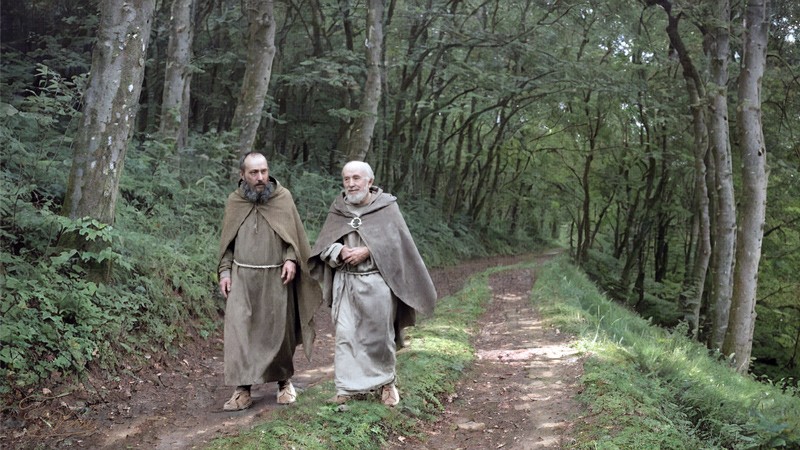
Saints Columbanus and Deicolus in later life. Natural baldness was common among elderly monks,
and the razor might not have touched their heads very often
—Saint Columbanus was known for his stubborn defence of Irish customs despite pressure to conform to Roman practice.
The "Celtic tonsure" was likely not a single, standardised form. It may have been whatever various Celtic monasteries did that wasn't the Roman corona.
Some scholars have speculated that the Celtic Christian tonsure originated from pre-Christian druidic practices, citing Iron Age sculptures from Celtic Europe interpreted as showing a distinctive "band" hairstyle (such as the Mšecké Žehrovice head from 3rd century BC Bohemia). This remains unproven conjecture: the sculptures may depict painted decoration rather than an actual hairstyle, the identification as specifically "druidic" (rather than broadly aristocratic) is uncertain, there is a 500-800 year gap with no evidence of continuity, and no medieval source states Christians adopted such a practice.
Celtic Christianity was decentralised. There was no Celtic Pope, no mechanism to enforce uniformity. Different monasteries honoured different founders and preserved different customs. When Roman sources describe the Celtic tonsure vaguely—"from ear to ear," "without crown"—they may have been seeing multiple variations that they lumped together under one hostile label.
When seventh-century Romans looked at Celtic monks, they saw variety, independence, and rejection of Roman authority. The "Celtic tonsure" may have been all of these things—a family of related practices, united only by the fact that they weren't the Roman crown.
Once Rome prevailed at Whitby and subsequent councils, the various regional forms were suppressed together. They vanished because there was no unified tradition to preserve—just scattered local customs that couldn't survive without institutional support.
Regional Variation, Not Standardisation
The evidence—or rather, the lack of it—points towards regional variation. The silence of Celtic sources suggests there was no standard to document. The vagueness of hostile Roman sources makes sense if they were describing multiple practices. The decentralised nature of Celtic Christianity created conditions for diversity, not uniformity.
For an artist attempting to depict seventh-century Irish clergy accurately, this presents a challenge. There may not be one correct answer. What matters is understanding that the distinction may have been not a specific haircut, but the rejection of Roman uniformity itself.
Conclusion
“But even the hairs of your head are all numbered.”
—Matthew 10:30 (RSVCE)
Honour 7th century Irish saint, Saint Deicolus of Lure, with us in prayer and scripture.
This video tribute invites you to reflect on his quiet fidelity,
unite your petitions with his intercession, and remember his joyful perseverance in exile, labor, and prayer.