
ENTER OUR VIDEOS
RECEIVE OUR WORK
Enter our full collection of
sacred video meditations on YouTube.
Be notified quietly by email of
our reflections and new videos, free of charge.
The Test:
How Christians Were Condemned to Martyrdom in Ancient Rome
“But if not, be it known to you, O king,
that we will not serve your gods
or worship the golden image
which you have set up.”
—Daniel 3:18 (RSVCE)
How did Roman authorities test accused Christians? What did they demand? And why did thousands choose death rather than comply?
In the year 112 AD, Pliny the Younger wrote to Emperor Trajan with an administrative problem: Christians had been denounced in his province of Bithynia, and he wasn't sure what to do with them. "I have never been present at trials of Christians," he admitted. Should he distinguish between ages? Pardon those who recant? Punish the name itself or only crimes associated with it? And crucially
—how exactly should he test whether someone was truly Christian?
Trajan's reply was brief: don't hunt them, but if accused and they refuse to recant, punish them for obstinacy. As for the test itself? Make them invoke the gods, offer incense and wine to the emperor's image, and curse Christ. Those who comply go free.
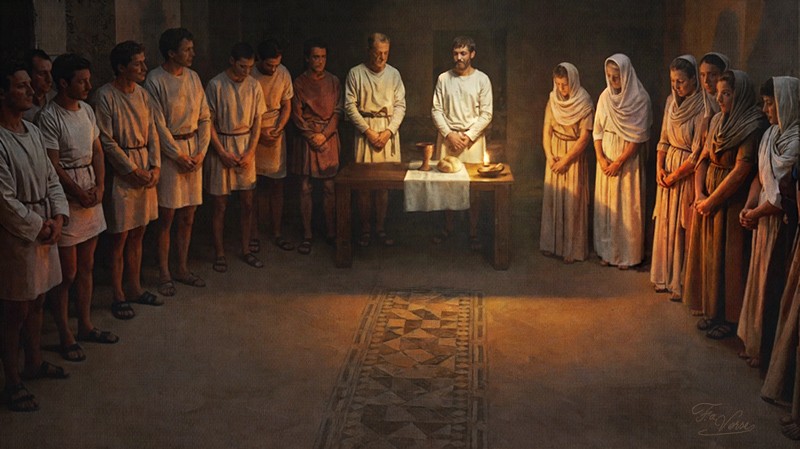
meeting in private homes, were vulnerable to denunciation by neighbors, slaves, or business rivals.
To modern readers, this exchange reveals something unexpected: the governor of an entire province had to ask the emperor how to conduct a loyalty test. What we call "the test"—the ritual demand that Christians prove loyalty by sacrificing to Roman gods—was not a uniform, codified protocol but an improvised response to a recurring problem.
Over 1,900 years later, we still speak of Christian martyrdom as though the process was consistent: Christians were arrested, brought before tribunals, ordered to sacrifice, and executed when they refused. The imagery is fixed in Christian memory—lions in the Colosseum, burning stakes, defiant confessions before sneering magistrates. But the historical evidence suggests something more complicated.
Perhaps there was no single "test" to reconstruct.
The standard account runs like this: Roman authorities demanded Christians perform a loyalty ritual—burning incense to the emperor's image, pouring libations to the gods, sometimes eating sacrificial meat, and cursing Christ. The specifics varied by period: Pliny's test emphasized the oath and incense; Decius's 249 AD empire-wide edict required an actual animal sacrifice with official witnesses and a signed certificate (libellus) proving compliance; Diocletian's persecution added mandatory surrender of sacred texts.
Archaeological evidence confirms some consistency. Surviving Egyptian papyri from Decius's reign record formulaic declarations: "I have always sacrificed to the gods, and now in your presence I have poured a libation and sacrificed and tasted the offerings." Two commissioners witnessed and signed. The physical setup typically included a public altar, bronze brazier for incense, statues of gods or the emperor, and wine for libations.
But this apparent uniformity masks profound variation. The Decian libelli come overwhelmingly from Egypt—papyrus survives there. Evidence from Rome itself is sparse. What looks like "the standard test" may be an artefact of Egyptian record-keeping.
What We Think We Know
Our sources fall into two categories, neither neutral.
First, Christian martyrologies—the Acts of Polycarp, Perpetua, Justin Martyr. These texts preserve vivid dialogues: the proconsul demanding "Swear by the genius of Caesar," the martyr replying "I am a Christian," the crowd roaring for blood. Written generations after the events by communities venerating the martyrs, they blend memory and meaning. They tell us how Christians understood martyrdom; what they reveal about Roman bureaucracy requires careful interpretation.
Second, Roman administrative documents—Pliny's correspondence, Decian papyri, imperial edicts. These provide outcomes and occasional procedures but little systematic instruction. Apart from Pliny's letter to Trajan—which itself is a request for guidance rather than transmission of established protocol—we have no Roman documentation explaining standard procedures for testing Christians. What survived were certificates of compliance, records of execution, occasional imperial correspondence. The tests themselves went largely unrecorded.
Hostile Witnesses and Administrative Silence

Roman persecution of Christians was neither continuous nor uniform. Roughly twelve out of fifty-four emperors between Nero and Constantine actively sanctioned persecution. The rest ignored Christians, tolerated them, or explicitly protected them. Between the major waves—Nero (64 AD), Decius (249-251), Valerian (253-260), Diocletian (303-313)—Christians worshipped largely undisturbed.
But this episodic nature made persecution no less real for those who lived under its threat. Christians in the 2nd and 3rd centuries faced genuine danger. Any denunciation could trigger interrogation. Any refusal could mean death. The unpredictability was part of the persecution—it could erupt through personal grudge, mob violence, or sudden imperial decree.
Between 64 and 313 AD, thousands of Christians chose death rather than deny Christ. That is an army of martyrs. During active persecution periods, Christians represented a substantial proportion of those executed by Roman justice. The sporadic nature of these campaigns didn't make them less real. It made them more arbitrary, hinging on local grudges and officials' whims.
Christian memory of living under persecution reflects this reality. The threat was real even when not actively enforced. Communities remembered their martyrs not because they misunderstood Roman policy but because they had watched friends, family members, and spiritual leaders die for refusing rituals that seemed meaningless to Romans but were apostasy to Christians.
Even during persecution periods, enforcement varied wildly by region. Decius's edict is well-documented in Egypt and the eastern provinces but barely visible in Rome. Diocletian's "Great Persecution" was ferocious in the East under Galerius, perfunctory in Gaul under Constantius (Constantine's father). Pliny's 112 AD test was informal. Decius's 249 AD system was bureaucratic with mandatory certificates. The ritual adapted to the purpose.
Judicial authority also varied. Provincial governors held trials in their courts. In Rome, the Urban Prefect heard cases (Justin Martyr before Junius Rusticus, 165 AD). But lower officials could act independently. The Praefectus Vigilum—commander of Rome's fire brigades and night watchmen—had evolved by the 3rd century to handle minor criminal matters, including interrogations and limited punishments. A tribune commanding a cohort could conduct preliminary investigations. A military officer could judge soldier-Christians for insubordination.
A Christian's fate depended enormously on who arrested them, where, and why.
The Pattern of Diversity
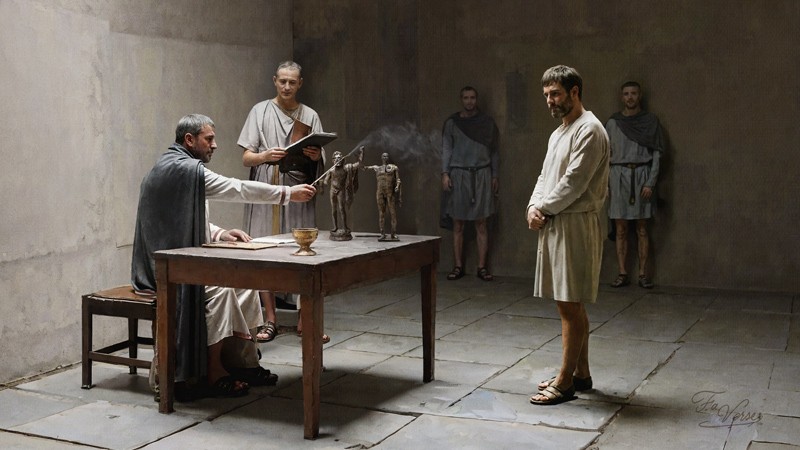
Roman officials saw civic duty; Christians saw apostasy.
The evidence reveals a pattern:
1. Trigger: Most persecutions began with denunciation. Pliny received an anonymous list of names. Polycarp was betrayed by his slave. An angry ex-lover, a business rival, a pagan relative offended by conversion—these drove accusations more than imperial policy. Pliny himself notes: "Without a denunciation, no persecution at all would have occurred."
2. Arrest: Local authorities responded. In provinces, the governor's staff. In Rome, the Vigiles or Urban Cohorts depending on severity. Arrest reflected the perceived threat: a priest caught proselytizing rated the night watch, not the emperor's guard.
3. Interrogation: The arresting authority—or the official they reported to—questioned the accused. This is where "the test" happened. What was demanded depended on who was asking. Pliny made them curse Christ specifically because he'd heard Christians couldn't do that. Decius's commissioners wanted proof of sacrifice. A military commander might demand acknowledgement of the emperor's divinity. A local magistrate might accept a pinch of incense. Roman officials typically gave accused Christians multiple opportunities to comply. Pliny describes questioning suspects 'a second and third time, threatening punishment' before executing those who persisted in refusal. The goal was compliance, not death. But when personal grudges or mob pressure drove denunciations, this procedural norm could be bypassed—one refusal followed by immediate condemnation.
4. Outcome: Compliance meant release (often with documentation). Refusal meant punishment—but what punishment depended on citizenship status, the official's authority, and local custom. Roman citizens were beheaded. Non-citizens might face crucifixion, burning, or arena execution. Many officials lacked authority to execute and had to refer cases upward. Others released the accused with warnings or minor punishment.
The Mechanics of Local Enforcement
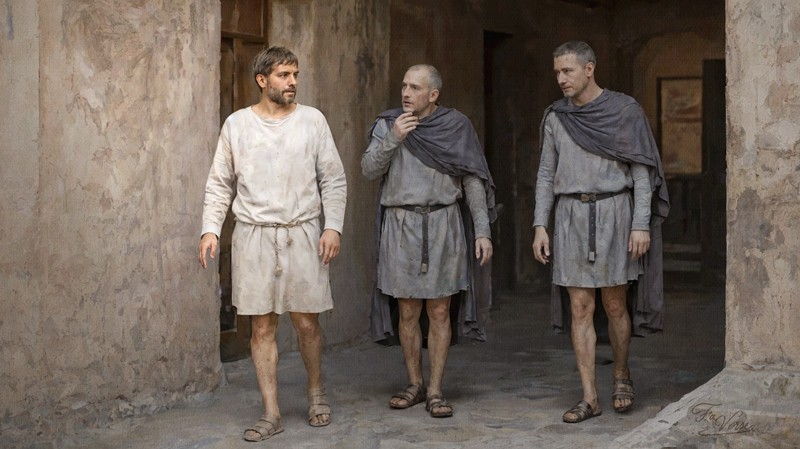
Let's consider a priest in Rome during the 260s—after Gallienus granted toleration but before Diocletian's persecution. The priest has converted an elite woman to Christianity. A spurned suitor denounces him: "This Christian undermines public morals."
The Vigiles arrest him. He's brought to an excubitorium. Small altar, bronze brazier, incense, statue, wine. "Burn incense. Pour wine. Swear by the gods." Refusal, quiet but final. Scourging ordered, then execution. Via Flaminia, roadside. Community burial nearby.
Later generations remember a martyr. But at the time: denunciation, local enforcement, improvised test, execution outside normal hierarchies. No grand tribunal. No systematic persecution. Just bureaucratic machinery activated by personal malice.
A Mid-Third-Century Example
If procedures varied, what made them all "the test"?
Not the specific ritual—that changed by period and place. Not the judicial process—that was inconsistent. Not imperial policy—that was episodic.
What unified them was the demand itself: Choose between Christ and Roman order. Whether it was Pliny's oath, Decius's certificate, or a local magistrate's brazier, the core conflict remained: Christians refused to perform acts that Romans considered minimal civic duty, and Romans couldn't comprehend why anyone would die over a pinch of incense.
What United the Tests
To understand why Christians died rather than comply, we must understand how profoundly Roman and Christian conceptions of the divine differed.
For Romans, the gods were forces woven into the fabric of reality—Fortune, Victory, the Grain Supply, the Health of the Emperor. Some Romans believed these were conscious beings who could be pleased or angered through proper ritual. Others understood them as names for patterns in nature and society—ways of conceptualizing why fortune and misfortune happened, why some prospered and others failed. Many Romans participated in state religion with little personal conviction, viewing it simply as civic duty that maintained social order. The gods (or the principles they represented) received honour not because every Roman believed in their personal existence, but because the rituals bound communities together and maintained the pax deorum (peace with the gods)—the peace with divine forces (however one conceived them) that kept the state functioning.
Roman religion was fundamentally transactional and pluralistic. Romans honoured the gods (or performed the civic rituals) to maintain order. A Roman could honour many gods without contradiction. Religion was public duty, not private conviction. The ritual demonstrated loyalty to Rome's social fabric. Whether a Roman personally believed Jupiter existed as a conscious being mattered far less than whether they participated in his cult when required.
Christianity was different in kind, not degree. Christians worshipped the Creator God—not a force within nature but the Source of nature itself—who had become flesh in Christ, a historical person born, crucified, and risen. This was not one god among many but the only God, whose lordship was absolute and exclusive. To acknowledge other gods—even as mere civic theatre, even without interior belief—was to deny that Christ alone was Lord. To burn incense before an idol was to participate in worship of what Christians understood as demons or empty nothings. The act itself mattered because it was a public declaration.
Romans saw incense-burning as political theatre. Christians saw it as apostasy.
Neither side could comprehend the other's position. Romans found Christian refusal insane: why die over civic ritual one could perform whilst privately keeping one's faith? Christians found Roman demands impossible: how could they deny Christ publicly and claim to follow Him at all?
Two Worldviews in Collision

Lions in the arena remain the iconic image of Christian martyrdom,
though most executions were bureaucratic rather than spectacular.
The conflict was not between foreigners and natives. These were Romans judging Romans. Christians being executed were Roman citizens—often from respectable families, frequently well-educated, sometimes from the very social classes staffing the magistracies that condemned them. Justin Martyr was a Roman citizen and philosopher. Perpetua came from a prominent North African family. The priests, the soldiers who refused to sacrifice, the bureaucrats and artisans martyred across the empire—all were Romans.
The conflict was internal to Roman society: What does it mean to be Roman? Can one be Roman and Christian? Traditional Romans said no—to refuse the state cults was to reject Romanitas itself, to endanger the community by angering the gods. Christians said Christ transcended earthly citizenship but didn't negate it. They paid taxes, obeyed laws, and prayed for the emperor's health. What they wouldn't do was worship him or acknowledge other gods.
This made persecution fundamentally a civil conflict over identity, not ethnic or religious warfare between separate peoples. When a magistrate ordered a Christian to sacrifice, he was often condemning a social peer, perhaps a former colleague, sometimes a relative. When crowds demanded Christian blood, they were turning on neighbours. The martyrs died not as conquered foreigners but as Romans who had redefined what Rome meant—and whom Rome could not tolerate.
Romans Against Romans
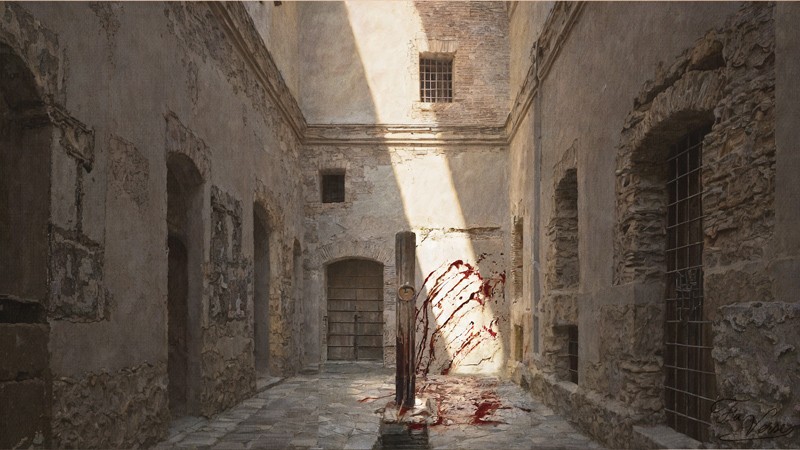
The tests evolved to make the choice explicit. Early procedures were informal because Christianity seemed like minor eccentricity. By Decius's time, after decades of Christian growth during the Crisis of the Third Century—Gothic invasions, plague, economic collapse—Christianity appeared as a threat to civic unity. The test bureaucratized because the perceived stakes had risen.
But even at peak standardization under Decius, enforcement depended on local officials' zeal, popular hostility, and Christian visibility. When crowds demanded Christian blood (Polycarp at Smyrna, the martyrs at Lyon), officials conducted tests not just to enforce imperial policy but to satisfy mob anger and restore civic peace.
Christians who understood what the test demanded refused it. Christians who didn't often complied, received their certificates, and lived quietly—the lapsi (the lapsed), who outnumbered martyrs but left almost no literary trace. The martyrs we remember are those who recognized that the choice was absolute: Christ or Rome, with no middle ground.
Conclusion
The evidence points towards a conclusion: "the test" was not a standardized imperial protocol but a family of related practices united by their goal rather than their method.
Roman authorities improvised based on local circumstances, available resources, personal motivations, and their understanding of what "loyalty" required. Christians responded based on their convictions and courage. The collision produced martyrdom—sometimes spectacular, usually bureaucratic, always contingent.
For those attempting to depict 3rd-century martyrdom, this presents a challenge. There may not be one correct procedure to show. What matters is understanding that martyrdom emerged from the intersection of Roman administrative pragmatism, popular hostility, occasional imperial decree, and Christian conviction.
The test was real. But it was also many tests, varying across three centuries and an empire.
When we honour the martyrs, we honour those who chose Christ despite that variation—who refused whatever test they faced, administered by whoever had authority over them, for whatever reason they'd been denounced.
The constancy was in their witness, not in Rome's procedure.
Resistance and Authority
"Remember the word that I said to you,
'A servant is not greater than his master.'
If they persecuted me, they will persecute you."
—John 15:20 (RSV2CE)
Saint Valentine of Rome likely faced a test like those described above
—refusing to burn incense, pour libations, or acknowledge the emperor's divinity.
Watch our short video with scripture and prayer honouring his witness