ENTER OUR VIDEOS
RECEIVE OUR WORK
Enter our full collection of
sacred video meditations on YouTube.
Be notified quietly by email of
our reflections and new videos, free of charge.
The Long-Haired Kings:
Royal Hair and Hairstyles in Merovingian Francia
“A razor has never come upon my head;
for I have been a Nazirite to God from my mother’s womb.
If I be shaved, then my strength will leave me,
and I shall become weak, and be like any other man.”
—Judges 16:17 (RSVCE)
In early medieval Francia, a pair of scissors could become a political weapon.
In AD 524, King Chlodomer died in battle, leaving three young sons. His brothers, Childebert I and Chlothar I, feared that the boys might one day claim their father's inheritance. According to Gregory of Tours, they sent Arcadius to their mother, Queen Clotild, bearing a pair of scissors and a sword. She faced a terrible choice: her grandsons could have their hair cut and be excluded from royal life, or they could be killed.
Overcome by grief and anger, Clotild replied: “If they are not to become kings, I would rather see them dead than shorn.” Gregory records that she spoke without considering her words. Arcadius carried her answer back to the brothers.
Two of the boys were murdered. The third escaped.
To modern eyes, the choice between a haircut and death seems almost incomprehensible. But among the Merovingians, the dynasty that ruled the Frankish kingdoms from the fifth to the eighth century, hair carried a significance far beyond personal appearance.
Their kings were known as reges criniti—the long-haired kings.

The traditional image of the long-haired Frankish king has a substantial historical foundation.
The Greek historian Agathias, writing in the later sixth century, described Merovingian kings whose hair was allowed to grow from childhood.
He wrote:
ἀκειρεκόμαι τέ εἰσιν ἐκ παίδων ἀεὶ καὶ παρηιώρηνται αὐτοῖς ἅπαντες εὖ μάλα ἐπὶ τῶν ὤμων οἱ πλόκαμοι.
“They remain unshorn from childhood, and all their locks hang down upon their shoulders.”
—Agathias, Histories, I.3.4.
Agathias continued that the hair was parted at the forehead, falling to either side, and was carefully washed, combed and maintained.
This was not the tangled hair of an unkempt warrior. It was a deliberate, recognizable royal appearance.
Other evidence supports Agathias's description.
The signet ring of Childeric I, who died in AD 481, depicts a ruler with long hair divided around his face. The original ring was discovered in his tomb at Tournai in 1653 and later disappeared following a theft in 1831, but impressions and reproductions preserve its design.
A forensic study published in 2016 identified human hairs embedded in six early medieval royal wax seals, including two Merovingian examples. The hairs cannot securely be identified as the kings’ own. Whether they helped strengthen the wax, held symbolic meaning, or served both purposes remains uncertain.
Bishop Avitus of Vienne also referred to the cultivated hair of King Clovis, who ruled from 481 to 511. Writing to congratulate Clovis on his baptism, Avitus imagined the ceremony in these words:
cum sub casside crinis nutritus salutarem galeam sacrae unctionis indueret
“When his cultivated hair beneath the helmet received the saving helmet of sacred anointing.”
—Saint Avitus of Vienne, Epistula 46, to Clovis.
Avitus was not present at the baptism, and his words are a literary evocation of the ceremony rather than an eyewitness description. Nevertheless, his reference to Clovis's cultivated hair is consistent with the wider royal tradition.
These testimonies come from different sources and generations. Together, they establish that long royal hair was an authentic Merovingian custom—not merely an invention of later medieval artists or nineteenth-century historical painters.
What Did Merovingian Kings Look Like?

Saint Columbanus escorted from Burgundy by Frankish soldiers, AD 610.
Agathias claimed that ordinary Franks were not permitted to grow their hair like their kings. Yet no surviving Frankish law establishes an exclusive royal right to long hair.
Indeed, the Salic Law, compiled and revised across several generations, includes a provision punishing someone who cuts the hair of a free, long-haired boy without his family's permission. The provision survives in particular recensions of the law and cannot simply be assumed to belong to its earliest form.
The distinction between royal and ordinary hairstyles may therefore have involved more than length alone.
Perhaps kings wore their hair exceptionally long, maintaining it without ordinary cutting from childhood. Perhaps the distinctive parting and arrangement mattered as much as the length itself. Or perhaps Agathias described a social custom more strictly than it was actually observed.
What we can say is that Merovingian kings possessed a recognizable tradition of long hair. What we cannot establish is a written law preventing every other Frank from wearing something similar.
Was Long Hair Reserved for Kings?
Hair could also become an instrument of political exclusion.
Gregory of Tours, writing in the later sixth century, describes several royal princes whose hair was forcibly cut or who were given clerical tonsure. Such actions were often accompanied by removal from court and confinement in a religious house.
The meaning was unmistakable. A man who had been visibly marked as a potential king could be made to appear instead as someone who had renounced secular power.
Clerical tonsure also possessed its own religious significance, although its form varied between Christian communities. Differences over the practice would later become particularly visible in the seventh-century controversy surrounding the Celtic tonsure.
Yet the political consequences of cutting royal hair were not necessarily permanent. Hair could grow again, and circumstances could change. Theuderic III, for example, was shorn and removed from power in 673, but subsequently returned to the throne.
Historians have proposed various explanations for the deeper significance of royal hair, including inherited Germanic customs and later Christian associations with Samson, whose uncut hair appears in the Old Testament.
The surviving sources do not tell us precisely what the kings themselves believed about their hair.
Their beards present a separate question.
The fifth-century Gallo-Roman poet Sidonius Apollinaris described Frankish warriors with shaved cheeks and narrow strips of carefully combed facial hair, generally understood as moustaches. In his Glory of the Confessors, Gregory of Tours also tells of Childeric, a man at the court of King Sigebert I, whose hair and beard fell out during an illness.
We therefore have no reason to imagine every Frankish king or soldier with the enormous beard familiar from later romantic paintings.
A king such as Theuderic II, who ruled Burgundy from 595 to 613, can reasonably be pictured with long, carefully groomed hair around AD 610. His noblemen and armed retainers may have worn shorter styles, although some could also have possessed considerable length. Whether the king himself wore a beard or moustache remains uncertain.
Theuderic's reign was also the setting for the conflict that led to the expulsion of Saint Columbanus from Burgundy in 610.
The historical Frankish world was almost certainly more varied in appearance than the familiar image of uniformly long-haired, heavily bearded Germanic warriors suggests.
Hair, Beards and Royal Authority
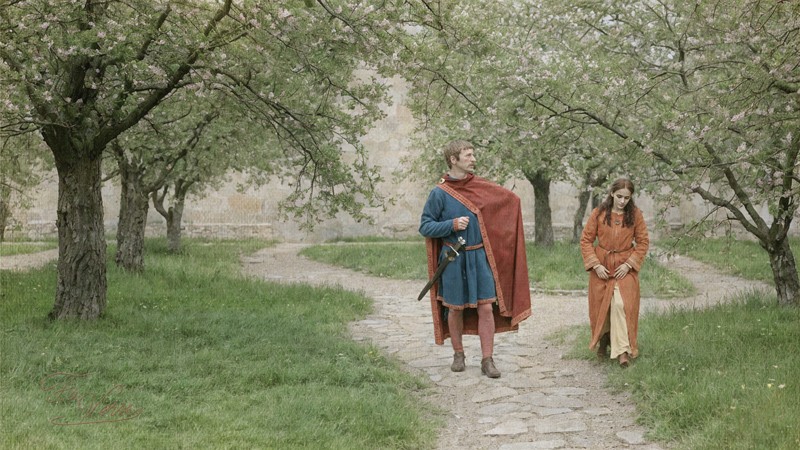
Saint Aldegundis with a noble suitor, c. 655.
The royal tradition endured for generations.
Even in AD 751, when the last Merovingian king, Childeric III, was deposed as the Carolingian dynasty took power, the cutting of his hair accompanied his removal from kingship and confinement in a monastery.
By then, the long-haired kings had ruled the Franks for nearly three centuries.
Their distinctive appearance had become part of how royal identity was recognized and remembered. Yet the deeper meaning of that custom remains partly beyond our reach. It may have begun as an inherited mark of lineage, acquired further significance through political ceremony, and continued within a Christian kingdom whose rulers preserved many older traditions.
And there is one final detail worth remembering.
The third son of Chlodomer, the child who escaped the violence following his father's death in 524, was named Chlodovald.
He survived, but did not pursue the throne. According to Gregory of Tours, he eventually cut his own hair and entered religious life.
The prince who might have worn the long hair of a Merovingian king was remembered instead as Saint Cloud.
In the hands of his uncles, the scissors had represented humiliation and the loss of royal inheritance. In his own hands, cutting his hair became a voluntary renunciation of earthly power.
The same outward act could carry two very different meanings.
The hair of the Merovingian kings was a visible sign of their place in the world. Yet one of the children who inherited that royal tradition chose to lay it aside.
His brothers were murdered because others feared their claim to a kingdom. Chlodovald survived and freely renounced his own.
Of the three, he is the one whom the Church remembers as a saint.
What the Hair Remembered
Honour Saint Columbanus with us in prayer and scripture.
This video tribute remembers his faithfulness to his monastic vocation,
his perseverance in exile, his courage before kings and bishops, and his lifelong dedication to the Church.

Honour Saint Aldegundis with us in prayer and scripture.
This video tribute invites you to reflect on her steadfast consecration,
unite your petitions with her intercession, and remember her faithful endurance in illness, leadership, and prayer.