
ENTER OUR VIDEOS
RECEIVE OUR WORK
Enter the full collection of our
tributes to Saints on YouTube.
Be notified quietly by email of our prayers,
reflections and new videos, free of charge.
Saint Ludmila of Bohemia

Saint Ludmila of Bohemia—Patronage & Symbols
Born: c. 860, Mělník (Pšov), Bohemia
Died: 15 September 921, Tetín, Bohemia
Traditional Feast Day: 16 September
Modern Roman Calendar Feast Day: 16 September
Canonized: Pre-Congregation—cult began immediately after death (921); translation to Prague 925 established public veneration
Patron Of: Bohemia (Czech lands), converts to Christianity, widows, those with difficulties involving in-laws, grandmothers, Christian educators
Symbols in Art: Veil, crown (marking her status as duchess)
Invoked For: Family harmony when religious differences cause conflict, protection of children's Christian education, strength for Christian witness in hostile environments, support for new converts, guidance for responsible leadership
Svatá Ludmila, Liudmila, Ludmiła, Ludmilla
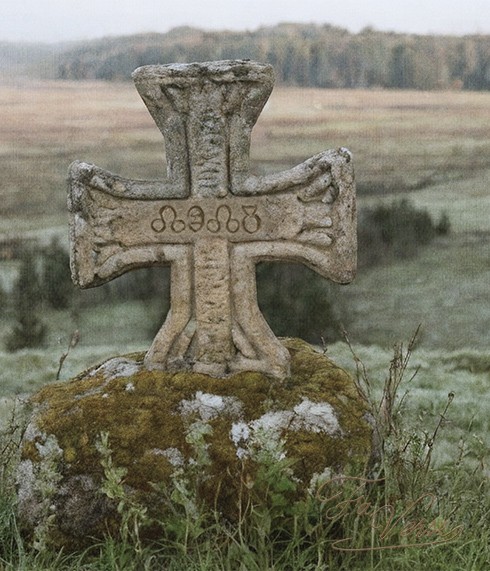
Ludmila was born around 860 at Mělník (known in early sources as Pšov), in the region that would become central Bohemia. Later chronicles name her father as Slavibor, Duke of Pšov, though this attribution appears only in later medieval sources and cannot be verified from contemporary records. What is documented is her position within the Slavic nobility of the region and her marriage into the emerging Přemyslid dynasty.
Ludmila stands at the threshold where Bohemia first enters written Christian memory. Her death was remembered early, narrated repeatedly, and used to frame the Christian identity of the Přemyslid court. Even when details shift from text to text, the core arc remains stable: an older duchess, tied to the first Christian ruling house, accused of steering a young heir toward a Christian policy, removed by violence, then honoured by translation and cult.
Remembering Saint Ludmila of Bohemia
Birth and Family
Saint Methodius baptizes Ludmila in Moravia, marking the beginning of her Christian life
—a moment that would one day shape the faith of Bohemia.

Ludmila was the wife of Duke Bořivoj I, among the earliest historically attested Přemyslid rulers associated with the beginnings of Christian court life in Bohemia. In the biographical tradition she is placed firmly inside the first dynastic Christian turn: wife of the founding duke, mother of the next generation (including Spytihněv I and Vratislav I), and grandmother of Václav (Wenceslaus), who would become the most celebrated saint of the dynasty and whose formation became inseparable from Ludmila's own legacy.
Traditional accounts place the baptism of Ludmila and Bořivoj under the ministry of Saint Methodius, likely in the early 880s before 885. The timing is significant: Ludmila was already a mother when she accepted baptism, and the conversion of the ducal couple represented a decisive court alignment with Christianity, not merely a private devotional choice.
Bohemia in the late ninth and early tenth century was not a finished Christian realm with settled institutions. It was a ruling house consolidating power around Prague and its surrounding region, negotiating pressure and influence from neighbouring powers, while Christianity advanced through court patronage, clergy, and political alignment. In that environment, the faith of a dynasty was never purely private. It was policy, alliance, identity, and succession.
The decision provoked immediate resistance. A pagan faction among the Bohemian nobility drove Bořivoj and Ludmila into temporary exile. With military support from the Moravian ruler, they returned to Bohemia and reasserted their authority. The couple's reinstatement was followed by deliberate acts of Christianization: the construction of churches and the establishment of clergy, marking the dynasty's commitment to the new faith despite ongoing opposition.
Marriage, Baptism, and Exile
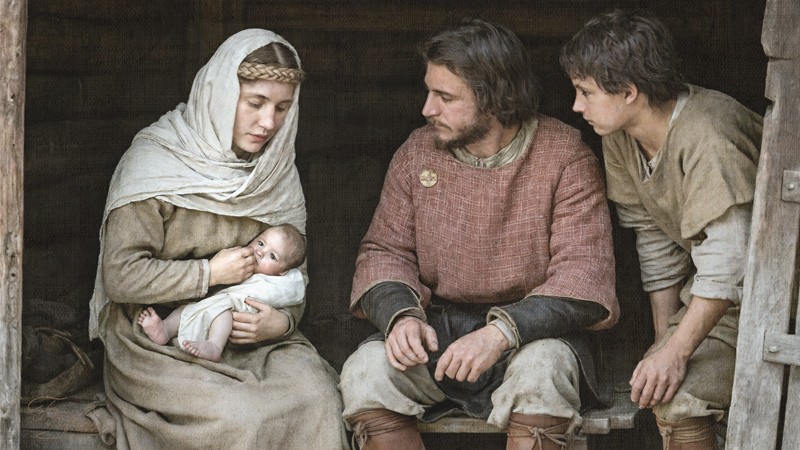
Ludmila and Bořivoj with their sons Spytihněv and infant Vratislav—the first Christian ducal family of Bohemia, c. 888.
Ludmila and Bořivoj are documented as having two sons who became rulers: Spytihněv I (c. 875–915) and Vratislav I (c. 888–921). Later tradition speaks of six children in total—three sons and three daughters—though only the two ruling sons appear by name in contemporary sources. The existence of additional children remains conjectural, inferred from the chronological gap between the two documented sons and from later chronicle references to "three sons and three daughters." No names or fates are recorded for these other children, and their inclusion in the family count belongs to later tradition rather than to early documented record.
Children and Family
After Bořivoj's death around 889, Ludmila remained a significant figure at court during her sons' reigns. Under Spytihněv I (894–915), the Přemyslid seat moved to Prague, and the dynasty maintained its alignment with Christian Bavaria and the Latin Church. The construction of the Church of the Virgin Mary at Prague Castle during this period reflects the continued advancement of Christian infrastructure. While no chronicle records Ludmila's direct counsel to Spytihněv, the consistency of Christian policy during his reign suggests her influence as the dynasty's elder Christian matriarch.
Widowhood and Dynastic Role
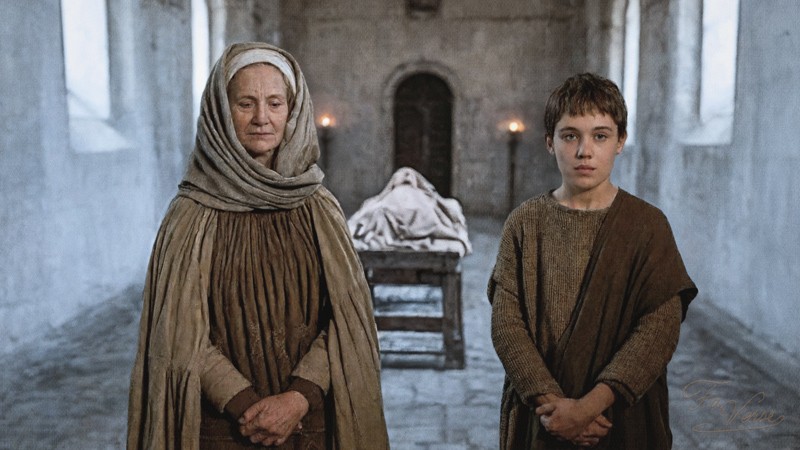
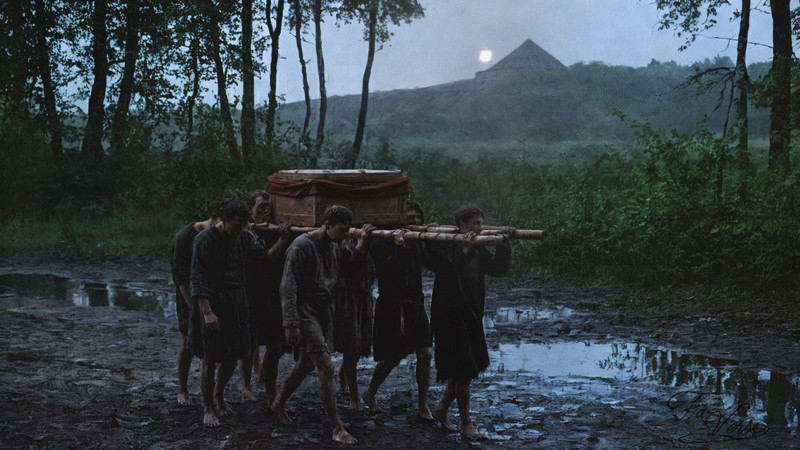
Ludmila stands with her grandson Václav (Wenceslaus) at the funeral of Vratislav I, 921
—the moment that would trigger the regency crisis and seal her fate.
Vratislav's death in 921—tradition records he fell in battle against Magyar raiders—left a minority succession crisis. His son Václav (Ludmila's grandson) was still young, and effective power centred on Václav's mother, Drahomíra. That is the political hinge on which Ludmila's final months turn: an older dynastic matriarch and a regent mother in conflict over influence, household control, and the direction of the realm.
The tradition frames Ludmila as attached to her grandson's formation, and Drahomíra as attached to a rival interest at court. The conflict is presented as governance: control of household, control of the boy, control of Bohemia's direction.
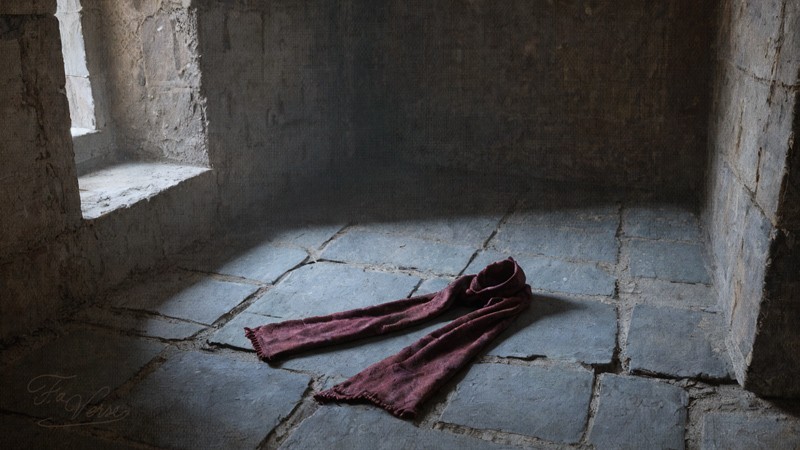
Ludmila was killed at Tetín on 15 September 921. The method is consistently remembered as strangulation. Later retellings sharpen the image by identifying her veil as the instrument.
At this point the tradition turns a political killing into confession and witness. Her death becomes the moment where the dynasty's Christian identity is tested by blood.
Some strands depict a later recall or re-appearance of Drahomíra in the political scene, often coupled with a narrative insistence that her effective authority is broken. Whether the historical mechanics were recall, controlled return, or permanent relegation, the tradition's own pressure is consistent: the regency conflict ends with Drahomíra's faction displaced and Ludmila's memory re-claimed by the heir's camp.
The Succession Crisis and Death
After her death, veneration follows quickly in the narrative world. She is treated as a martyr in dynastic memory, and her cult is anchored by the later translation of her remains into the Prague Castle ecclesial centre, tied to Václav and to the institutional centre of the dynasty.
In the early medieval cult of saints, translation is not a decorative after-event. It is the liturgical and political act that fixes a saint's place: moving the body from an initial grave into a church setting, binding the saint to an altar and to an institution.
The Ludmila tradition is anchored by the movement of her remains into the Prague Castle ecclesial centre, associated with St. George's Basilica. Sources aimed at the castle's own historical memory place the deposition there in 925, and this placement matters for what it implies: the ruling power now publicly claims her sanctity at the heart of the dynasty's seat.
When Ludmila's remains were translated to Prague in 925, the tradition records that her body was found incorrupt—a sign interpreted by contemporaries as confirmation of her sanctity. This detail appears in the early legend material associated with the translation and became part of the cult's validating narrative.
Translation and Cult
The Christian infrastructure established during Ludmila's lifetime and immediately following her death has left material traces that corroborate the written record. Excavations at Levý Hradec, near Prague, have confirmed the foundations of a small stone church dating to the late ninth century—identified as the Church of St. Clement, traditionally the first Christian church built in Bohemia under Bořivoj and Ludmila's patronage. The church's dedication to St. Clement reflects the influence of Cyril and Methodius, who brought relics of that saint to Moravia, underscoring the Slavonic liturgical connection that Ludmila and Bořivoj initially fostered.
Archaeological work beneath Prague Castle has revealed the remains of the Church of the Virgin Mary, built in the late ninth century on the site of a former pagan assembly ground. This physical layering—Christian sanctuary built atop pagan space—demonstrates how the dynasty's Christianization was expressed through deliberate architectural claims on the landscape.
At Tetín, where Ludmila was killed, surveys have found remains of a tenth-century fortified settlement. Later stone churches on the site trace continuity to her era, including a Romanesque church of St. Michael (12th–13th century), likely successor to the earlier chapel where Ludmila's body first lay. A Baroque Church of St. Ludmila, built in 1685, now marks the locale as a pilgrimage site, underscoring the lasting association of the place with her memory.
Archaeological Evidence
Ludmila's feast is kept on 16 September in both Catholic and Orthodox calendars. She is honoured as patron of Bohemia (the Czech lands), of converts to Christianity, of widows, and—uniquely among saints—of those with difficulties involving in-laws, a patronage rooted directly in the circumstances of her martyrdom.
Her primary shrine is St. George's Basilica at Prague Castle, where her relics were placed in 925. A dedicated Chapel of St. Ludmila was added in the 13th century. Her skull is preserved separately in the treasury of St. Vitus Cathedral and displayed publicly only on her feast day.
In Czech devotional practice, the St. Ludmila Trail forms a 132-kilometre pilgrimage route from Mělník (her birthplace) to Tetín (the site of her death). Tetín itself contains multiple churches associated with her memory, including a Baroque Church of St. Ludmila built in 1685.
Ludmila is iconographically depicted with a veil (recalling the tradition of her manner of death) and often with a crown, marking her status as duchess. In Czech national memory she holds the title "Matka českého národa" (Mother of the Czech nation), and her veneration is often paired with that of her grandson Václav, whose joint cult emphasizes the transmission of faith across generations.
Cult and Legacy
Shortly after Ludmila's death and burial at Tetín, miracles were reported at her tomb. The early tradition records healings of the sick and other signs interpreted as divine confirmation of her sanctity. These reports, preserved in the legend material compiled within decades of her death, formed part of the evidence supporting her early recognition as a martyr and saint. Later hagiographical material expands the miracle catalogue with additional details—lights appearing over her grave, cures of blindness, and other wonders—though these belong to the developed legend tradition rather than to the earliest stratum of cult memory.
Miracles
Over the centuries, the Ludmila tradition accumulated legendary embellishments that, while beloved in Czech devotional culture, cannot be historically verified. Among these is the vineyard legend: that Ludmila introduced viticulture to Mělník, even performing a symbolic libation that blessed the land's future wine production. While 9th-century viticulture is archaeologically attested in the region, the attribution to Ludmila appears to be a later cultural association linking a patron saint to a prized local product.
The detail that Ludmila was strangled with her own veil is universally repeated in hagiographical tradition, but early sources record only that she was strangled. The veil becomes prominent in later retellings, functioning as a symbolic element: the sign of her widowed consecration transformed into the instrument of martyrdom.
Other legendary elements include extreme ascetic practices (constant fasting, night-long vigils in unheated chapels) and visions, which belong to the idealized portrait of sanctity constructed by medieval hagiographers rather than to documented biography. These layers of legend do not diminish Ludmila's historical importance but demonstrate how her memory was shaped across generations to serve the devotional and political needs of Christian Bohemia.
Later Legends
Ludmila is not preserved for us through charters, letters, or contemporary court records. She is preserved through a cluster of saintly narratives that function as dynastic memory: some short and early, some expanded and politically sharpened, some written to serve liturgy, and others written to serve princely ideology.
The Source Tradition
The earliest kernel tradition presents Ludmila with severe economy: dynastic position, Christian orientation, conflict after Vratislav's death, removal at Tetín, and the beginning of a cult.
This kernel is where several stable elements already appear: Ludmila's standing as an older duchess with real household authority; the minority of the heir after Vratislav; the conflict between the heir's mother and the grandmother; assassination as targeted removal rather than open warfare; the immediate framing of the death as martyrdom inside Christian memory.
The Early Kernel Tradition
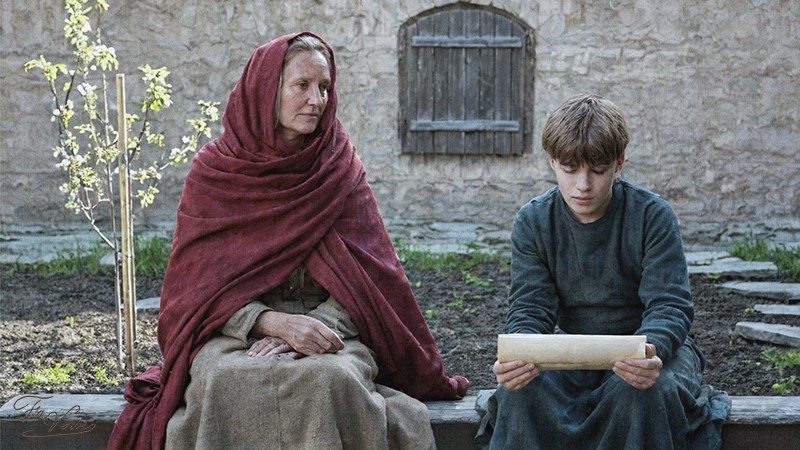
Saint Ludmila of Bohemia guides the young Václav in the ways of Christian wisdom
—shaping the soul of a future martyr and the faith of a nation.
The most influential shaping text for Ludmila is the work traditionally attributed to "Christianus," transmitted as Vita et passio of Václav and Ludmila. Whatever one concludes about precise authorship and dating, this text is the first to give Ludmila a fully articulated narrative role: not merely an ancestor, but a governing presence whose influence over the heir triggers a decisive household rupture.
Here the tradition hardens into a recognizable pattern: Ludmila is attached to the education and formation of Václav. Drahomíra is attached to a rival court alignment and is portrayed as hostile to Ludmila's influence. The dispute is not presented as domestic jealousy. It is presented as rule-by-proxy: whoever governs the boy governs the realm.
In Christianus, the murder at Tetín is carried out by named agents, and the emphasis falls on the manner of death—strangulation—as the act that seals martyrdom.
Christianus and the Narrative Development
Other Latin legends about Václav preserve Ludmila as background structure: the grandmother who forms the heir, the sainted matriarch whose violent removal defines the moral landscape of the court. These texts do not exist to give Ludmila a biography. They exist to sanctify the prince. But precisely because of that, they show how early and how firmly Ludmila had become part of the sanctified dynastic frame: she is the first martyr of the court, and the prince's holiness is built inside a household already marked by martyr blood.
Alongside the Latin dossier stands a liturgical-memory stream transmitted in Old Church Slavonic and later prolog traditions. This current matters because it shows that Ludmila's remembrance was not confined to Latin court narrative alone. She also entered the rhythms of ecclesial commemoration and reading cycles, which preserve saints by repetition and use rather than by dramatic expansion.
This strand tends to be compact, schematic, and cult-facing: it preserves names, feast logic, martyr framing, and basic narrative joints. Its importance is not that it supplies new "facts," but that it witnesses to the breadth and durability of the cult-memory.
Gumpold's Václav legend belongs to a different world: the rhetoric of princely sanctity shaped for elite audiences and imperial courts. Ludmila appears as part of the moral architecture that produces the sainted prince. In this layer, the story is not only Bohemian memory. It becomes exportable ideology: a Christian ruler made intelligible to a broader Latin world.
Other Latin and Slavonic Traditions
Cosmas is not a first-line witness for Ludmila's death. He is a later chronicler writing with the priorities of a different century. But he cannot be ignored, because his Chronica Boemorum shows the state of the tradition after generations of political use and ecclesial repetition: Ludmila and Václav are already fixed as defining figures of Bohemian Christian memory, and their stories are already working as national-dynastic narrative material. Cosmas therefore functions less as a source for raw events than as evidence for how the legend cluster had stabilized and what kinds of emphases later Bohemia wanted to carry forward.
Cosmas as Later Witness
A central claim repeated across the tradition is that Ludmila and Bořivoj were baptized in connection with the mission world of Methodius. In the dossier this is not decorative sacramental colour. It is the founding claim that explains why the dynasty is remembered as "first Christian," why church patronage is meaningful, and why opposition becomes narratively inevitable.
Within the logic of these texts, "conversion" is not described as a whole-land event. It is described as a court event with political consequences: a Christian ruling household creates enemies, factions, and eventual violence.
The safest approach is to hold the biography to the early core: dynasty, baptism tradition, succession crisis, murder, translation, and the emergence of a cult bound to Prague.
Ludmila is historically important because her narrative functions as an origin story for Christian Bohemia in three linked ways: dynastic Christianity at the founding of the ruling house; Christian succession embodied in the struggle for the boy's formation; and a cult publicly anchored at the centre of dynastic power.
What Can Be Held as Firm

"Fuit in provincia Bohemorum" (early kernel text), in Josef Chaloupecký, Prameny X. století legendy Kristiánovy o sv. Václavu a sv. Ludmile (Prague: Svatováclavský výbor, 1929)
Legenda Christiani (Vita et passio s. Wenceslai et s. Ludmillae aviæ ejus), ed. Petra Ivanic, Kristianova legenda a počátky křesťanství v Čechách (Prague: Ústav pro českou literaturu AV ČR, 2023)
Old Church Slavonic Prologues on St. Ludmila, Czech Academy of Sciences: https://www.slu.cas.cz
Gumpold of Mantua, Passio sancti Wenceslai, in Monumenta Germaniae Historica Scriptores 4 (Hanover: Hahn, 1841), pp. 211–223
Cosmas of Prague, Chronica Boemorum, ed. Bertold Bretholz, Monumenta Germaniae Historica Scriptores rerum Germanicarum, Nova series vol. 2 (Berlin: Weidmann, 1923)
Latin Passiones and post-Christianus Wenceslaus cycles, compiled in Monumenta Germaniae Historica Scriptores rerum Germanicarum
Primary Historical Sources
Michael Ott, "St. Ludmilla," The Catholic Encyclopedia, Vol. 9 (1910), Newadvent.org
Martin Wihoda, "Christianisation of Bohemia," in Christianisation of Central Europe, ed. Ivan Hlaváček (Prague, 2003)
Antonín Kalous, Christianus: Vita et Passio Sancti Wenceslai et Sanctae Ludmillae, Masaryk University, MUNI Digital Library, Digilib.phil.muni.cz
David Kalhous, Legendy o svatém Václavu v historickém kontextu (Brno: Masaryk University Press, 2011)
St. George's Basilica, Prague Castle Official Site, Hrad.cz
Prague City Tourism, Prague.eu
Secondary / Reference Sources
Honour Saint Ludmila with us in prayer and scripture.
This video tribute invites you to meditate on her witness,
unite your petitions with her intercession, and remember her steadfast faith in Christ.
