
ENTER OUR VIDEOS
RECEIVE OUR WORK
Enter the full collection of our
tributes to Saints on YouTube.
Be notified quietly by email of our prayers,
reflections and new videos, free of charge.
Saint Alena of Brussels
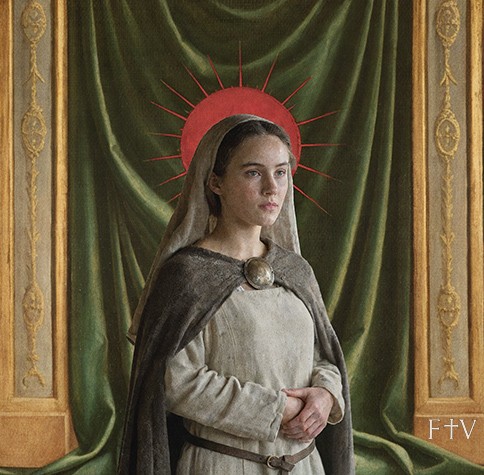
Saint Alena of Brussels—Patronage & Symbols
Born: Dilbeek, northern Austrasia (now Belgium), date unknown—traditionally seventh century
Died: Forest (Vorst), c. 640, by tradition; historicity unverified
Traditional Feast Days: 17 June (Brabant local solemnity, dominant historical usage); 19 June (martyrological stream); 16 June (modern Belgian/Brabantine local)
Canonised: Pre-Congregation—cult formally recognised by elevation of relics at Forest, 19 May 1193, under Abbot Godeschalk of Affligem and with the authority of the Bishop of Cambrai
Patron of: Those suffering from eye disorders and blindness (older, well-attested patronage); toothache in later local tradition (see note below)
Symbols in Art: Severed arm; angel associated with the arm's miraculous transport to the Forest altar; tree or tree-stump; occasionally depicted healing a blind man
Name variants: Alena, Alène, Alina (vernacular cult forms); Helena, Hélène (learned Latinate variants)
Alena of Forest, Alena of Belgium, Alène de Forest, Alena van Vorst, Sancta Alena

Modern compilations routinely list toothache among Alena's patronages. The claim is not supported by any medieval, seventeenth-century, or eighteenth-century source in the accessible critical record. The Bollandists themselves noted that toothache was absent from the early miracle dossier.
The most probable explanation is relic-based rather than dossier-based: a fifteenth-century reliquary at Forest preserved the saint's mandible, and local practice naturally associated the jawbone relic with dental ailments. The heritage documentation for Forest records that people went to Alena's tomb specifically for toothache relief within living memory of the guide's composition, explaining the devotion as deriving from the jaw relic rather than from any miracle in the written tradition.
The devotion is intelligible on its own terms: the community at Forest drew a connection between what they held and what they needed, as pilgrims have always done. The toothache patronage can be understood as a late local development, rooted in relic practice rather than in the legend or miracle dossier. The eye-healing patronage, by contrast, is documented from the miracle dossier itself and represents the historically earlier medical specialisation of the cult.
A Note on Toothache Patronage
Remembering Saint Alena of Forest
Saint Alena belongs to the very small group of saints whose cult is both historically real and historically opaque—where a thousand years of continuous veneration has preserved a name, a place, and a legend, while the seventh-century person behind the tradition remains effectively out of reach. She is not a literary invention. She is not a misidentified artefact. She is a saint whose community would not let her go. What that community preserved, and how they shaped and sustained the memory across a millennium, is the history we can actually tell.

Very little, if the standard is contemporary documentation. The local documentary record at Forest begins in 1105, when Bishop Odo of Cambrai granted the churches of Forest and Uccle to Affligem Abbey. By 1117 an archdeacon's charter refers to nuns serving God in the church of Forest; by approximately 1125, donations to the church of St Mary at Forest are recorded. The earliest secure mention of the church at Forest belongs to the institutional history of a twelfth-century Benedictine foundation, not to a seventh-century martyrdom.
The cult is securely visible from 1193, when Abbot Godeschalk of Affligem elevated the relics at Forest with the permission of the Bishop of Cambrai—an act that functioned as effective canonisation. From that moment, Alena's cult is historically documentable: a cenotaph, a shrine, a pilgrimage tradition, a written dossier, and a cult that over the following centuries acquired printed lives, a painted cycle, formal relic authentication, and an archbishop's ruling on the competing territorial claims of two communities.
What precedes 1193 is almost entirely silent in the written record. No charter, inscription, letter, chronicle entry, or early martyrological notice independently attests Alena before the late medieval dossier. The Vita sanctae Alenae (BHL 265) is a High or Late Medieval composition, with modern scholarship placing its first redaction either at the moment of the 1193 elevation or no earlier than the late thirteenth century.
What Can Be Said with Confidence
The legend places Alena in a specific historical milieu: the Brussels region of northern Austrasia in the mid-seventh century, a landscape where Christianity was present but not yet complete, and where a noble pagan household and a secretly Christian daughter could coexist within the same social world. That setting deserves scrutiny, because it is one of the few elements of the story that can be tested against external evidence—and what the evidence returns is more complicated than the legend suggests.
The nearest major seventh-century Christian centre to the Forest-Dilbeek zone is not Forest itself but Nivelles, to the south, founded under Amandus's influence around 646-647. Paul Fouracre's commentary on the Vita Sanctae Geretrudis places this foundation as part of a 'second wave of evangelisation in northern Francia,' and notes that pagan enclaves still existed near the Pippinid lands at mid-century. Nivelles establishes that Christian institutional life was active in the wider region—but it also establishes how far that life was from Forest and Dilbeek.
For the Brussels micro-region specifically, the evidence is stark. Paulo Charruadas, synthesising the region's history before the year 1000, notes that we remain 'in complete obscurity' about the mechanisms of Christianisation there—a situation he attributes explicitly to the distance from Cambrai's episcopal centre and the absence of major abbeys in the Brussels zone. The earliest securely attested Christian sites within the micro-region itself emerge mainly in the ninth to eleventh centuries. Forest does not appear as an autonomous parish until 1105.
Amandus himself—the missionary whose influence reaches Nivelles—cannot be placed in Forest, Dilbeek, or Brussels. Charles Mériaux's reconstruction of the secure Amandine dossier places his activity primarily along the Scheldt corridor. The bishops of Cambrai, in Mériaux's assessment, were 'weakly interested in territories farther north toward the sea' in the Merovingian period. The Forest-Dilbeek zone should be imagined less as a well-parished Christian heartland than as a marginal area in which episcopal oversight was thin and later monastic networks would matter disproportionately.
The comparative Merovingian evidence does show that non-Christian practices survived in the northern countryside. Conciliar texts from Orléans (541), Tours (567), and Clichy (626/627) continue to legislate against practices classified as superstitious or pagan—rites centred on trees, springs, and rocks, not a coherent rival religion but a residue of cult behaviours persisting alongside Christian life. Yitzhak Hen has argued forcefully that Merovingian Gaul was 'basically Christian' and that pagan survivals have been overemphasised in older scholarship. A careful use of the comparative material supports a background of unfinished religious transformation—not a uniformly pagan countryside. The hagiographic genre itself magnifies this ambiguity: Mériaux notes that scenes of pagan destruction and immediate church-building closely echo the older Vita Martini—a reusable saintly script that can stylise or invent the local scene as readily as it records it.
The conclusion for the biography is precise. Around 640, the Forest-Dilbeek-Brussels zone lay on a weakly integrated northern periphery of Cambrai, receiving Christian institutional pressure from nearby monasteries and wider Merovingian networks, while some non-Christian practices may still have persisted in residual form. A household religiously mixed, half-Christianised, or attached to older cult practices while Christian institutions were gaining ground nearby—that is plausible in this setting. A documented openly pagan Frankish aristocrat ruling in Dilbeek at this exact date is not attested. The legend's 'pagan father, secret Christian daughter' pattern is a narrative compression—perhaps of real social tension, but in the form of a hagiographic dramatisation, not a recoverable social fact.
The World the Legend Paints
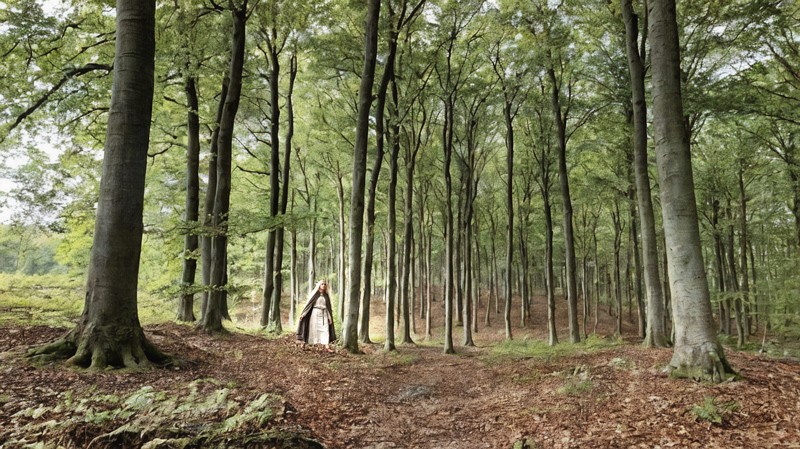
What follows is the account as the community of Forest handed it down across the centuries. It is not seventh-century testimony, and it does not need to be read as such to matter. It is the story told to explain who Alena was, why Forest was her place, and what her death meant. The theological logic embedded in the narrative is real and coherent. The memory it encodes—of a young woman who would not be turned back, whose faith was known before she was found—is the reason the community would not let her name go.
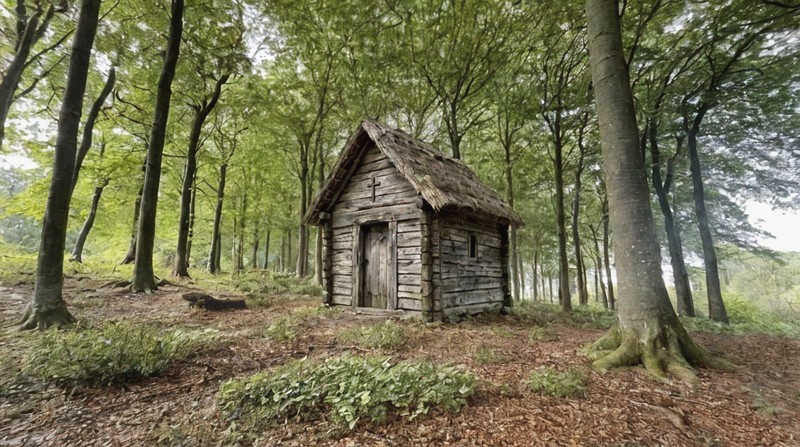
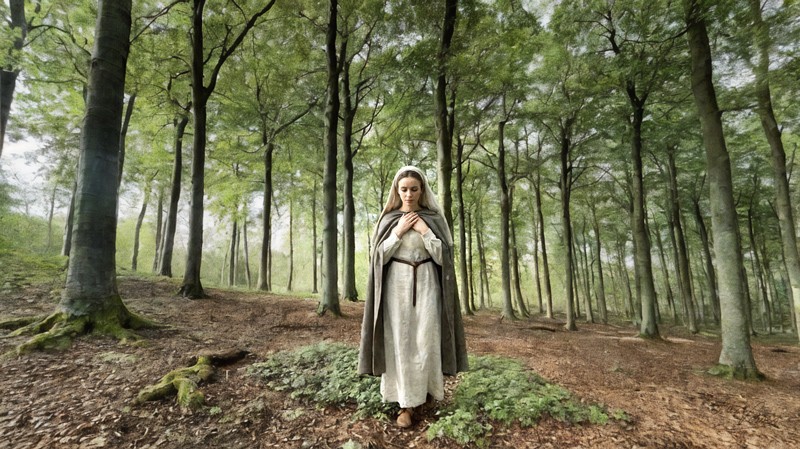
According to the tradition, Alena was born in Dilbeek, the daughter of a pagan local lord named Levold and his wife Hildegard. She was baptised without her parents' knowledge—a detail that immediately establishes the story's central tension: faith held secretly within a household that does not share it. As a Christian, she attended Mass at a chapel in Forest, journeying from Dilbeek under cover of darkness, leaving behind a world that did not yet know what she had become.
When her father discovered her Christian worship, he did not interpret it as a daughter's free choice. He interpreted it as enchantment. He sent his men to bring her home. On her return from Forest, the men seized her. In the struggle, her arm was torn from her body.
She died at the spot. But the tradition does not end with her death. An Angel of the Lord—the same angel who had accompanied and protected Alena in life—took her severed arm and carried it to the altar of the chapel at Forest. The very altar she had secretly visited. The place she had prayed alone in the dark hours.
The priest and a local lord found the arm on the altar. They searched the woods and found Alena's body. They buried her at the chapel that would become, in the centuries that followed, the centre of her cult. A subject of Levold named Duke Omundus, who had lost his sight, recovered it by invoking Alena's intercession at her burial site. Her parents, the tradition records, converted to Christianity.
The Legend of Alena: What the Tradition Preserved
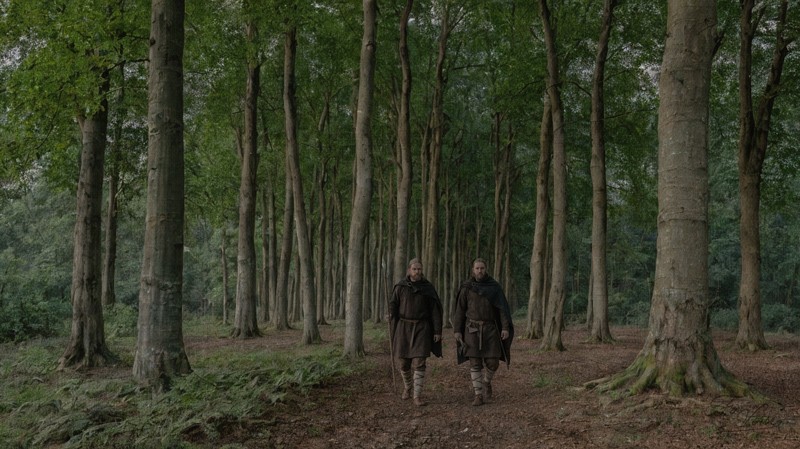
The arm carried to the altar is not hagiographic excess. It is the legend's most carefully constructed moment, and the author of BHL 265 knew it—which is why he defended it against anticipated disbelief before narrating it.
The scene accomplishes three things simultaneously. It provides an unmistakable post-mortem sign of sanctity at the moment of death. It turns the detached limb into the cult's first explicit relic—not yet translated to a reliquary, but carried by an angel to the most sacred place in the Forest landscape. And it resolves the legend's geography in favour of Forest: the martyrdom occurred on the road from Forest back toward Dilbeek, but the angel does not carry the arm to Dilbeek. He carries it to the altar at Forest. Heaven chooses the site of the cult.
The BHL text frames this within a precise theological vocabulary. Virginity is akin to the angels—which is why the angel who accompanied Alena in life does not abandon her in death. Her shed blood functions as the baptism of a martyr. The arm scene is embedded in this logic: a virgin-martyr, baptised in blood, her sanctity authenticated by heaven at the place of prayer.
The altar destination deepens the meaning further. In Christian practice from late antiquity onward, the altar was the appropriate destination of martyrs' remains—the Eucharistic focal point, and the place where, following Revelation 6:9, the souls of the slain were understood to rest. Ambrose of Milan's installation of saints' relics beneath altars established the precedent that shaped centuries of relic practice. Alena's legend dramatises in narrative what liturgical architecture expressed in stone: the martyr belongs at the altar.
There is no clear hagiographic subtype for this exact motif—an angel carrying a severed limb to an altar. The Alena scene participates in the broader Christian grammar of relic translation and altar-centred martyr cult, but in its specific form appears to be the legend's own distinctive invention, shaped to serve the particular needs of the Forest cult.
The Severed Arm: Theological Logic of the Legend's Central Image
The core Latin dossier is BHL 265, edited by the Bollandists in Acta Sanctorum, June vol. III, pp. 388-396. The edition was prepared from the Dilbeek manuscript with collation from two Forest manuscripts and one from Rouge-Cloître/Rooklooster near Brussels—four witnesses constituting the full named manuscript tradition of the printed critical dossier. The Bollandists regarded the text as composite: an older account ending after the first chapter, followed by a further section, with additional later material beyond that. The dossier was not a single transparent narrative but an accretive hagiographic file assembled across time.
Modern scholarship divides on when the dossier first took written shape. Podevijn's skeptical judgment dated the Vita to the late thirteenth century and treated it as historically without value. Cult-history scholarship linked to IRPA/KIK places the first redaction at the moment of the 1193 elevation. Both positions agree that the text reflects the needs of a High Medieval monastic community, not seventh-century oral memory.
Thomas van der Noot printed a Middle Dutch Legende van Sinte Alena in Brussels around 1518, illustrated with approximately eleven woodcuts—among them explicit scenes of the arm-severing and the angelic deposition at the altar. French printed editions followed from 1621 onward. The 1753 editors explicitly restored the name-form Alene against the classicising Hélène of the 1679/1697 tradition, stating that 'all the old writings call her Alene.'
The Written Dossier
The most serious scholarly challenge to the legend's account of origins is the cenotaph at Forest. The tomb slab—one of the finest late Romanesque monuments of its type in Belgium—bears the inscription + SCA HELENA +, not Alena. The carved figure wears a monastic habit and holds a book or psalter. No palm, no severed arm, no tree, no martyrdom attribute. Art-historically, the monument does not visualise Alena's legend. It depicts a nun.
Podevijn and art historian Jean-Claude Ghislain proposed that the cult may have originated not with a seventh-century martyr but with a twelfth-century religious woman connected to the Forest monastery established under Affligem from 1105. In this reading, miracles at her grave led to the promotion of a cult, and only later was she elevated, in memory and narrative, into a heroic Merovingian martyr. Ghislain dated the inscription itself to around 1193 or shortly thereafter—making it a contemporary of the elevation, not evidence for the seventh century.
A more cautious formulation from the Despy school suggests the sculptor simply did not know Alena's biography and depicted the dead as a moniale, with the name sancta Helena added later at Forest.
The name-form alone does not resolve the question: Molanus also called her Helena, demonstrating that the learned tradition already knew the variant. The real weight of the hypothesis rests on the combination of monastic iconography, altered inscription, late cult evidence, and non-Merovingian relic dating—addressed in the following section.
The Helena hypothesis is the most serious alternative explanation for the Forest evidence. However, it remains unproven.
The Helena Hypothesis
The relics preserved at Forest were scientifically examined in connection with the 2006 Forest exhibition. The great reliquary in Saint-Denis was opened on 31 July 2006. Investigators found the remains of at least two individuals: one adult skeleton in relatively good condition, and one neonatal femur shaft—an infant under three months.
The adult skeleton was assessed at approximately 34-40 years of age, stature around 1.77 m, robust build. Morphological, microscopic, and radiographic analysis pointed toward a male assessment, though DNA confirmation failed. Radiocarbon dating of the adult sample (KIA-30654) returned AD 780-980 at 95.4% probability; the newborn sample (KIA-30655) returned AD 880-1000, with a combined probable range of AD 885-980. A small fragment of animal bone was also identified among the remains
—a detail the investigators note without further explanation, and one that illustrates the complexity of how relic ensembles accumulate over centuries of shrine use. The association of adult and newborn remains was not considered extraordinary in medieval burial practice, where infants who died without baptism were sometimes interred alongside an adult.
The researchers' conclusion is carefully stated: the bones are genuine early medieval human remains, probably from a real ground burial—and the robust adult may well have belonged to a socially prominent person—but they are not credibly the bodily relics of a seventh-century female martyr. Alena is the only case in their sample where anthropological evidence clearly contradicted the saintly attribution.
What the science establishes is narrowly this: these specific bones are not hers. It says nothing about whether she existed. The history of medieval relic practice—translation, redistribution, secondary deposition, the confusion of remains across centuries—is complex enough that non-matching bones at a shrine say very little about whether the original venerated person was real.
The 9th- to 10th-century dating of the bones may itself suggest that organised veneration at the site predates the 1193 formalisation by several centuries
—a possibility the written record cannot confirm but does not contradict. That dating also complicates the Helena hypothesis as much as it complicates the legend: bones from the Carolingian period predate the 1105 monastery foundation that the Helena theory requires. The evidence, honestly read, opens more doors than it closes.
The Relic Evidence: What the Bones Open
Alena's feast appears as 16, 17, 18, and 19 June in different traditions, with 28 July and 16 December also attached to her name in Polish calendar culture. The instability reflects a cult that never achieved stable universal Roman form, instead moving through local solemnity, manuscript martyrology, learned compilation, regional devotion, Orthodox reception, and personal-name tradition.
17 June is the earliest clearly explained date. Miræus and Molanus placed Alena here because it was the first possible calendar day on which the Sunday before the Nativity of John the Baptist could fall—the day of her solemn local veneration at Forest. 17 June is therefore a liturgical solution tied to a movable observance, not a historically secure martyrdom date.
19 June is attested in a different stream: a Brussels manuscript martyrology, a manuscript Florarium, and the usage of Greven, Galesinius, and Ferrarius. It functioned as a fixed martyrological date rivalling the movable Forest solemnity.
16 June is the dominant modern Belgian and Brabantine local date, likely a later regional stabilisation without a clearly dated medieval precedent. 18 June circulates in modern anglophone compilations but cannot be traced to any medieval witness.
The Polish dates—28 July, 16 December, and others—belong to the imieniny name-day tradition rather than to the historical Forest cult.
Taken as a whole, the feast instability confirms what the textual evidence suggests: a cult that consolidated late, diffused unevenly, and spread through devotional print and personal-name culture rather than through a universally fixed medieval observance.
The Feast: Why the Dates Wander
The cult at Forest from 1193 onward is the most documentable phase of Alena's history. The elevation by Abbot Godeschalk formalised a veneration already organised at the site; the cenotaph was in place; a chapel held the relics, later incorporated into the parish church.
The sixteenth century saw a notable flourishing. Thomas van der Noot's 1518 printed legend brought the cult to a wider vernacular audience. The Forest church preserves the oldest known painted cycle of the legend—a panel of twelve episodes dated 1527, including pilgrims kneeling at the shrine. Episcopal authentication of the relics followed in 1524.
Alongside Forest, Dilbeek maintained its own vigorous Alena devotion, centred on the saint's natal landscape: a healing spring, an annual feast, processions, and the distribution of water blessed for eye ailments.
Cult Development: Forest and Dilbeek
By the early seventeenth century, the competing claims of Forest and Dilbeek had become a formal ecclesiastical controversy. The dispute concerned specifically which of the two places preserved the body of Saint Alena.
Archbishop Mathias Hovius ordered Petrus Vinck, licentiate in theology and dean of Brussels, to examine the Forest relics on 25 September 1600. Vinck concluded they were Alena's bodily remains. Hovius ratified the finding on 14 February 1601. When Dilbeek did not accept the ruling, Hovius issued a further ordinance on 21 March 1601 forbidding the pastor, village authorities, and inhabitants of Dilbeek, under pain of excommunication, from publicly claiming that Alena's body rested in their church—while allowing processions and image-carrying to continue.
The ruling separated relic title from cultic usage: Forest held the bodily claim; Dilbeek retained the saint. This is the episcopal solution when a bishop wishes to end a scandalous duplication without extinguishing a deeply rooted local devotion.
The timing belongs to the Counter-Reformation programme in the Southern Netherlands after the end of the Protestant occupation. Hovius was actively standardising liturgy, commissioning investigation of miracle claims, and regularising saints' cults. A saint claimed in two places with competing bodily assertions was precisely the ambiguity a Tridentine bishop would move to resolve. Forest Abbey had material as well as devotional interests in the outcome—it had long profited from donations linked to Alena's cult.
Forest consolidated its position through print: an anonymous French booklet on Alena's life and miracles was printed in Brussels in 1603, specifically in the context of the renewed controversy.
The 1601 Dispute: Hovius and the Division of the Cult

Alena's patronage against eye disorders is the historically grounded medical specialisation of her cult. It is rooted in the legend itself—the Duke Omundus miracle is present in BHL 265 and illustrated in the 1518 woodcut cycle.
The Dilbeek cult organised itself around this patronage: the healing spring, the annual feast, procession, and blessing of water 'used for blindness, pains and ailments in the eyes'—sustained by printed festival material with a clear institutional identity.
By 1866 the eye patronage was expressed in explicit invocatory language on devotional prints: Patroonerse tegen de oogziektens. Monthly devotional services and an annual octave were still active at Dilbeek in the modern period.
Patronage: Eye Healing and Its Development
The instability of the name across the tradition is itself historically informative. The local cult name—preserved in the earliest accessible sources and consciously defended by the 1753 editors—is Alena or Alène. The Latinate form Helena appears in learned hagiographic usage from early in the tradition, including in Molanus. The cenotaph's SCA HELENA belongs to this learned tendency.
Whether Alena represents an early medieval vernacular name in its own right, or a local phonetic rendering of Helena that drifted from its classical original, is not settled. What is clear is that the community consistently preserved Alena while learned Latin tradition gravitated toward Helena.
The Name: Alena, Alène, Helena
Alena's iconography is governed by the legend and is therefore comparatively stable. She is represented with a severed arm, at or against a tree or tree-stump, sometimes in scenes involving the restoration of sight, and sometimes with an angel associated with the arm. These attributes are first systematically illustrated in the 1518 van der Noot woodcuts and the 1527 painted cycle at Forest.
The cenotaph inscription SCA HELENA and the monastic figure stand apart from this iconographic tradition—which is itself part of the argument for the Helena hypothesis. The standard Alena iconography, with its martyrdom attributes, belongs to the legend as told from the thirteenth century onward. The cenotaph belongs to a different visual logic.
Iconography
Alena cannot be known as a person in the ordinary historical sense. The seventh-century woman behind the cult left no trace in any contemporary source. Yet the argument for a real martyrdom in the partially Christianised periphery of Merovingian Cambrai remains the simpler explanation for the tradition as a whole. The setting is historically exceptional but plausible: a world of uneven Christianisation, household tension, local violence, and later shrine memory.
The Helena hypothesis raises a serious caution: the cult may have absorbed or reshaped the memory of a later religious woman associated with Forest. But this hypothesis carries the greater burden of proof. It must explain not only the cenotaph and monastic iconography, but also the persistence of a martyrdom tradition, the early-medieval character of the relic material, the Forest-Dilbeek geography, and the community’s long insistence that the person remembered was Alena, virgin and martyr. It remains an important alternative explanation, but not an equally strong one.
What can be known without doubt is the cult. And the cult is substantial: a cenotaph that is among the finest late Romanesque monuments in Belgium; a printed legend with woodcuts in 1518; a twelve-episode painted cycle in 1527; an archbishop's ruling with the threat of excommunication in 1601; monthly devotional services and an octave still active in the nineteenth century; a healing spring at Dilbeek drawing pilgrims from Brussels, Aalst, and the wider region.
These are not the traces of a fiction. They are the traces of a living community that organised itself around a name and a place and sustained that organisation across a millennium. The biography of Saint Alena is the biography of that commitment.
Alena's Historical Weight
Les reliques dites de Sainte Alène à Forest / De vermeende relieken van de Heilige Alena te Vorst, Bulletin de l'IRPA 32 (2006-2008).
Mark Van Strydonck, Marit Vandenbruaene, Mathieu Boudin, and Bart Fransen, 'Anthropology and 14C Analysis of Skeletal Remains from Relic Shrines: An Unexpected Source of Information for Medieval Archaeology,' Radiocarbon 51.2 (2009).
Scientific Studies
Renier Podevijn, study of the Vita Alenae, summarised in Revue du Nord 32 (1950).
Albert d'Haenens, 'Alena,' Bibliotheca Sanctorum.
Jean-Claude Ghislain, study of the Forest cenotaph (cited in Forest Guide).
Anna Dlabačová, 'De Legende van Sinte Alena: een gedrukt heiligenleven uit de late middeleeuwen,' in De heilige Alena: Verering en verbeelding (Forest, 2006).
De heilige Alena: Verering en verbeelding—Gids voor een bezoek aan de Sint-Denijskerk van Vorst (Forest, 2006).
Komt Pelgrims, Komt Hier: Devotioneel drukwerk voor bedevaartplaatsen in Vlaanderen en Brabant 1500-1580 (2021).
Monument.heritage.brussels, Forest, Place Saint-Denis.
Paulo Charruadas, 'De la campagne à la ville: Peuplement, structures foncières et croissance économique dans la région de Bruxelles avant l'an mil.'
Charles Mériaux, studies on the Merovingian diocese of Cambrai and Christianisation of the northern lowlands.
Paul Fouracre and Richard Gerberding, Late Merovingian France (Manchester, 1996).
Ian Wood, Jonas of Bobbio (Oxford, 2001).
Yitzhak Hen, Culture and Religion in Merovingian Gaul (1995).
Christopher Allison, 'Altar and Relic,' MAVCOR (Yale).
Secondary Sources
Honour Saint Alena with us in prayer and scripture.
This video tribute invites you to reflect on her hidden faith, her courage in the forest, and her witness as virgin and martyr.
