
ENTER OUR VIDEOS
RECEIVE OUR WORK
Enter the full collection of our
tributes to Saints on YouTube.
Be notified quietly by email of our prayers,
reflections and new videos, free of charge.
Saint Deicolus of Lure
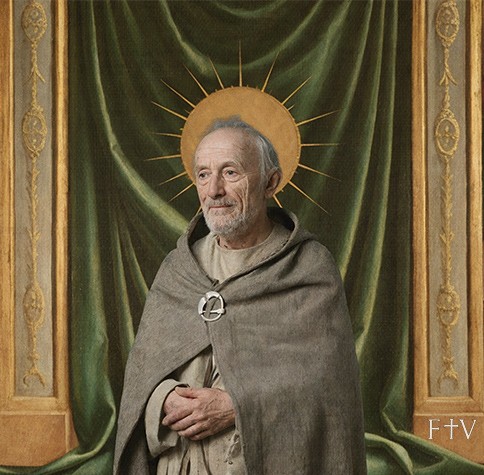
Saint Deicolus of Lure–Patronage & Symbols
Born: Ireland (c. 530)
Died: Lure, Vosges, (in what is now France), 18 January 625
Traditional Feast Day: 18 January—Honoured for his founding of Lure monastery, his peaceful contemplative life, and the cult of healing that grew at Gerbamont spring.
Modern Roman Calendar Feast Day: Removed 1969
Canonized: Pre-Congregation—cult attested immediately after death; tenth-century Vita composed by Theodericus preserved oral tradition and regional veneration
Patron Of: Sick children, childhood illnesses, livestock protection
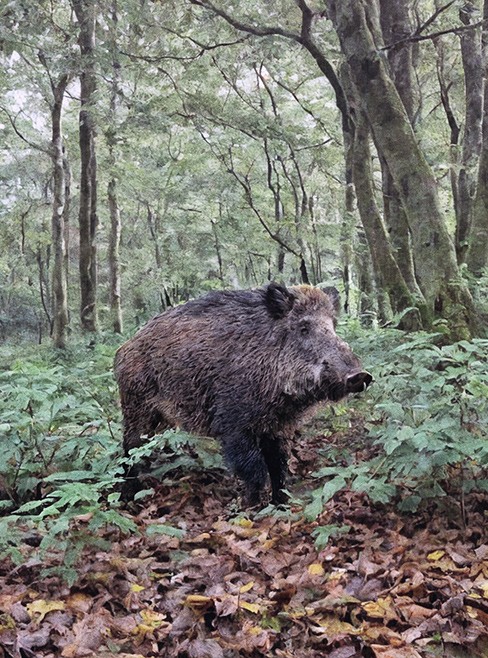
Wild boar (King Clotaire's hunt legend), elderly hermit monk, sunbeam (cloak miracle), healing spring, Celtic cross
Invoked For: Healing of sick children, protection of livestock, guidance for those seeking solitude in God, perseverance in monastic life, elderly monks and contemplatives, grace to remain faithful in old age.
Deicolus, Deicola, Déicole, Desle, Del, Dichul
Modern sources often claim Saint Deicolus was born in Leinster, Ireland. This claim has no basis in the early source tradition.
What the sources actually say:
Jonas of Bobbio, Vita Columbani (c. 640): Columbanus is from Hibernia (Ireland); no province is specified.
Vita S. Deicoli (10th century): No birthplace given for Deicolus.
Alban Butler, Lives of the Saints (1756): “Ireland” only; no province.
John O’Hanlon (1875): “Ireland”; explicitly states the particular place of nativity is unknown.
Margaret Stokes (1895): First prominent English print claim that he was a “native of Leinster,” while citing the Bollandists; the Bollandist dossier itself does not state Leinster.
Catholic Encyclopedia (1908): Popularized the line “born in Leinster”; widely copied online thereafter.
Conclusion: “Leinster” appears to be a late 19th-century attribution, not a medieval datum. Early sources support an Irish origin but specify no province.
What Is Known About the Origins of Saint Deicolus?
Deicolus belongs to the first generation of Irish monks who carried the distinctive forms of Insular monasticism into Merovingian Gaul. As a companion of the great missionary Columbanus and traditionally regarded as the elder brother of Saint Gall (a kinship asserted in the tenth-century Vita but absent from Jonas of Bobbio and all earlier sources), he represents the quieter, more settled strand of the Irish monastic diaspora—not the restless wanderer but the founder who took root in a single place and shaped it for centuries. His abbey at Lure, deep in the forests of the Vosges, became a centre of prayer and learning in eastern Francia, and his memory endured primarily as a regional cult tied to landscape, miracle tradition, and local devotion.
Remembering Saint Deicolus of Lure
The life of Deicolus is documented only in sources written long after his death. The principal witness is a Latin Vita S. Deicoli (BHL 2120-21) composed in the late tenth century, written by Theoderic, a cleric working at Lure abbey in the 970s or 980s at the commission of Abbot Werdolph. (Theoderic later moved to Sankt Maximin in Trier in 1006, but composed the Vita during his time at Lure.) This work survives in medieval manuscripts from the tenth through seventeenth centuries and was printed in early modern hagiographic collections including Mabillon's Acta Sanctorum Ordinis S. Benedicti (1669) and the Bollandists' Acta Sanctorum. The earliest complete manuscript is London, British Library, Add. 21917 (early 11th century). No seventh-century passio, Irish life, or Merovingian chronicle mentions him independently. Jonas of Bobbio's Vita Columbani (c. 640) mentions Columbanus's mission from Ireland but does not independently attest to Deicolus's presence among the companions.
From this late hagiographic tradition, a minimal historical outline can be extracted: Deicolus was an Irish monk who joined Columbanus's mission to the Continent around 590–591 (the occasional date of 576 is a confusion with Columba of Iona's mission to Scotland). He trained at Bangor Abbey in Ireland under Abbot Comgall and accompanied Columbanus to Luxeuil in Burgundy, where he remained from approximately 590 until 610. Alban Butler, in his Lives of the Saints, states that Deicolus "lived with [Columbanus] first in the kingdom of the East Angles, and afterward at Luxeu." This claim of an East Anglian sojourn is unattested in Jonas of Bobbio's Vita Columbani (c. 640) or the tenth-century Vita S. Deicoli. Given that East Anglia remained pagan until the 630s and that the Ireland-to-Gaul route would not naturally pass through eastern Britain, this may reflect the less fully distinguished historiography of Irish missions in Butler's time.
When King Theuderic II expelled Columbanus in 610, the elderly Deicolus (then about eighty years old) attempted to follow but fell ill and turned back. Guided by local inhabitants, he settled in the Vosges forest at a place called Lutre (modern Lure, Haute-Saône), where a noblewoman named Berthelde granted him her private chapel dedicated to St. Peter and surrounding land. There he founded a monastery around 611, following the Columbanian rule. He died as abbot on 18 January 625.
This core—Irish origin, companionship with Columbanus, foundation of Lure, death in 625—is consistent across late sources and preserved in the tradition, though early sources do not independently confirm these details.
The Historical Core: What Can Be Said with Confidence
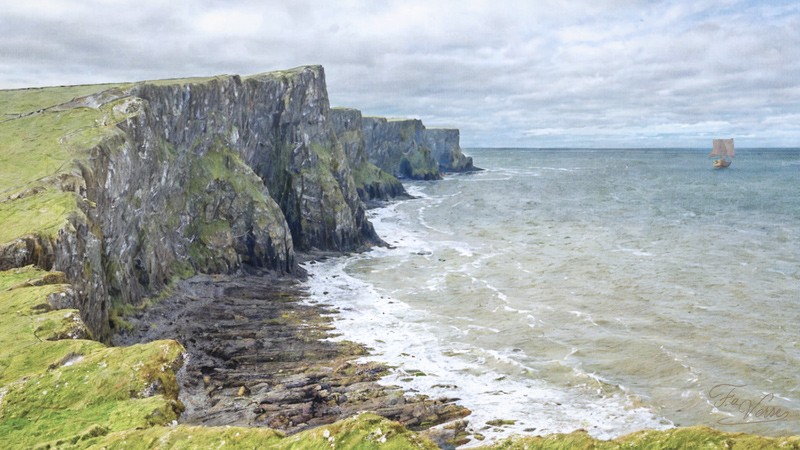
Columbanus's mission was one of the defining movements of early medieval Christianity. He left Ireland around 590 with twelve companions, establishing monasteries at Annegray, Luxeuil, and Fontaines under the protection of the Merovingian kings of Austrasia. The regime was rigorous: long fasts, ceaseless prayer, strict discipline, and manual labour. The community attracted vocations but also tension—Columbanus's refusal to soften his rule or bend to Gallic episcopal authority eventually led to his expulsion.
Deicolus was part of this world for two decades. As an elder monk (born c. 530, he would have been sixty when he arrived in Gaul and eighty at the time of expulsion), he was not a junior follower but a senior figure in the community. Tradition holds that he was Columbanus's elder by years and experience, a steadying presence. Alban Butler's Lives of the Saints preserves a tradition from their time together: St. Columbanus, observing Deicolus's constant serenity, asked him, 'Deicolus, why are you always smiling?" The reply came, "Because no one can take my God from me"—a response that captured the unshakeable faith he would carry through nine decades of life.
The Merovingian Mission and the Separation from Columbanus
"Deicolus, why are you always smiling?"
"Because no one can take my God from me."
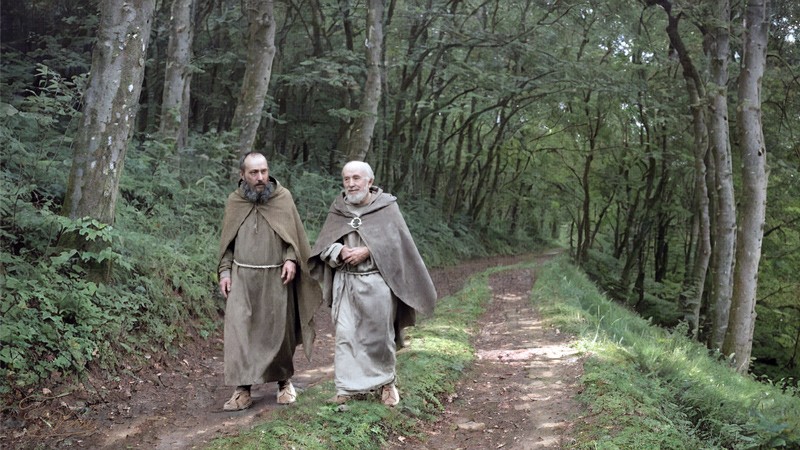
When Columbanus was ordered to leave Burgundy in 610, Deicolus set out with him but could not continue the journey. Whether this was due to illness, age, or a deliberate decision to remain and consolidate the mission in the Vosges is unclear. What is certain is that he did not accompany Columbanus into Italy, where the latter would found Bobbio. Instead, Deicolus turned back to Lure.
The abbey of Lure was established around 611 in a densely forested region. Archaeological evidence confirms early settlement at Lure, though no artefacts are directly attributable to Deicolus's era. According to the tenth-century Vita, King Clotaire II granted Deicolus lands, forests, and pastures after encountering the monk in the woods. The most famous element of this legend is the boar: Clotaire, out hunting, pursued a boar that took refuge beneath Deicolus's cloak. The king, moved by the monk's protection of the animal, spared the boar and endowed the new monastery. This story, absent from seventh-century sources, became a beloved tradition that shaped how later generations understood Deicolus's sanctity and his relationship with the created world.
The monastery followed the Columbanian rule—strict, penitential, shaped by Irish custom. Later tradition suggests that Deicolus moderated it somewhat toward the Benedictine form, though this may reflect later developments after his death rather than his own practice. In 817, the Council of Aachen formally replaced the Columbanian rule at Lure with the Benedictine, and the abbey eventually united with Murbach in the eleventh century. It prospered through the medieval period as one of the wealthier houses of eastern Francia before its dissolution during the French Revolution in 1791.
Deicolus himself lived as abbot for fourteen years, dying at approximately ninety-five years of age. He was buried at Lure, where his relics were immediately venerated.
The Foundation of Lure and Monastic Life
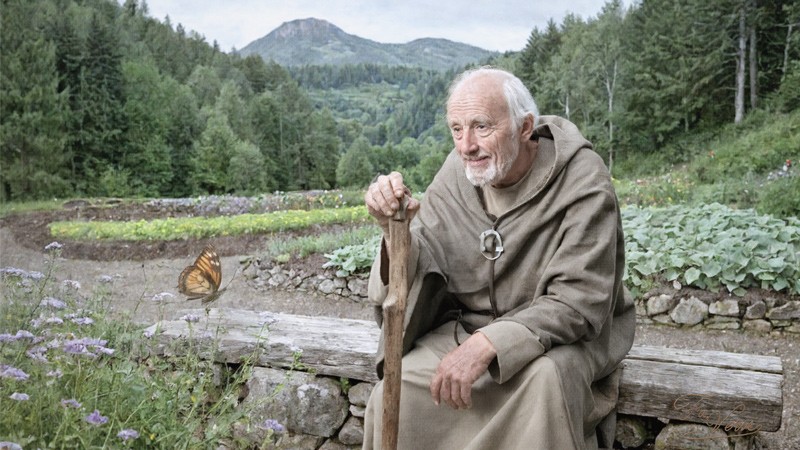
Deicolus's cult remained intensely local. His feast day, 18 January, was observed in the dioceses of Besançon and Lure, but he never achieved universal recognition. The tenth-century Vita and subsequent medieval calendars ensured his memory in the region, and his relics became the focus of pilgrimage. Medieval sources record that Duke Rodolphe IV of Baden acquired some relics in the tenth century to protect Lure, and later inventories note relics preserved in the abbey church into the seventeenth century.
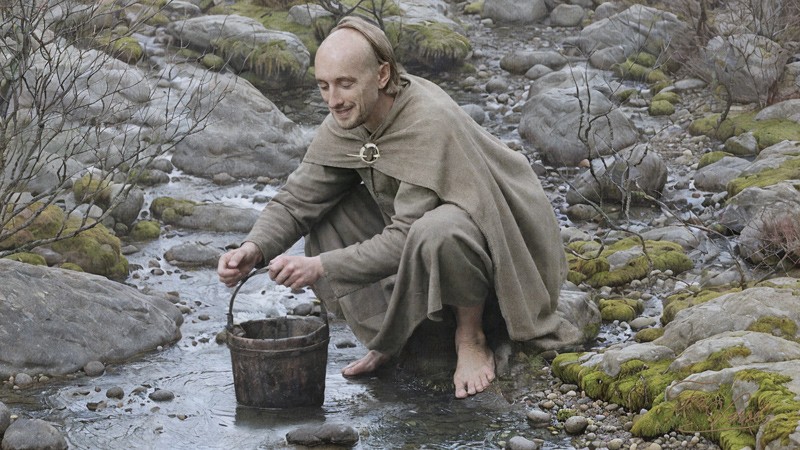
Pilgrimage sites developed at Lure itself and at the Chapelle Saint-Del in Gerbamont, where a spring Deicolus allegedly struck from rock became associated with healing, particularly for sick children. Parents would wash children's clothes in the spring or bring them to the chapel on his feast day. This tradition continued into the modern period. Deicolus was also invoked for livestock protection, a patronage that echoes the boar legend.
The geographic scope of his cult was limited: Lure, the adjacent Vosges and Haute-Saône frontier, and towns like Remiremont, Gerbamont, and Raon-aux-Bois. In these areas his name appears in place names and personal names (children named Del or Desle in his honour), but beyond this region he is little known. The Roman Martyrology lists him simply as "In Brittany, St. Deicola, abbot, disciple of St. Columban"—an error that has persisted since at least the sixteenth-century editions and is almost certainly a geographical confusion or scribal mistake, as Lure is emphatically not in Brittany.
Cult, Relics, and Regional Devotion
Nearly every vivid detail of Deicolus's life comes from the tenth-century Vita and later centuries. The boar story, the suspension of his cloak on a sunbeam, the striking of a spring from rock, the taming of wild animals, the multiplication of beer for monastery workers—all belong to the tradition of miracle stories that developed around his memory. He is also said to have commanded a bear to plough his fields after it killed his ox, another animal-taming tale that reinforced his reputation as a saint who lived in harmony with the wild creatures of the Vosges.
Late sources claim noble birth, kinship with St. Gall (as his elder brother), and even genealogical links to the Etichonid family through Queen Waldrada. None of these claims appears in Jonas of Bobbio or other seventh-century sources. A claim that he travelled to Rome for papal approval of his rule appears only in very late sources.
Modern scholarship treats these elements cautiously—his Acts were written centuries later, by a monk. The broad outline (Irish monk, companion of Columbanus, founder of Lure, death in 625) stands, while the miraculous stories and genealogical details developed in later centuries.
The Legendary Overlay
In art, Deicolus is depicted as an elderly hermit accompanied by a wild boar. The most famous image is Baumgartner's 1747-48 engraving "St. Deicolus and the Boar," showing the saint with the animal at his feet and a halo above his head. Sometimes a beam of light alludes to the cloak miracle. Little medieval iconography is securely identified; most imagery dates from the Baroque period or later folk tradition.
His patronage developed from the Lure spring legend: he is invoked for sick children and childhood illnesses. He is also locally venerated as a protector of livestock. Churches dedicated to him remain in the Vosges region, particularly the Chapelle Saint-Del at Gerbamont and the historic abbey church at Lure (now the parish church of Saint-Martin). In the Vosges he is sometimes called "Saint Desle" or simply "Saint Del," and older people still speak of "aller à Saint-Del" for the pilgrimage to Gerbamont. These vernacular forms—Deicolus, Deicola, Déicole, Desle, Del, Diey, Dichul—represent the living presence of an ancient cult adapted across centuries and languages. The name derives from Latin "Deicola" (servant of God) or Irish "Dichuil," reflecting his devotional life. This linguistic continuity binds the seventh-century Irish monk to the forests and villages of modern Franche-Comté. His feast is traditionally observed on 18 January in local devotion at Lure and Gerbamont, though it is no longer in the universal Roman Calendar (removed 1969) or the current archdiocesan ordo of Besançon.
Iconography and Patronage
Vita S. Deicoli (BHL 2120-21), late 10th century. Printed in Jean Mabillon, Acta Sanctorum Ordinis S. Benedicti (1669); Acta Sanctorum, Januarius II (1643, 1863 editions); G. Waitz, Monumenta Germaniae Historica, Scriptores XV (1888, incomplete).
Jonas of Bobbio, Vita Columbani (c. 640), references Deicolus among Columbanus's companions but gives no independent account.
Primary Sources
Alban Butler, The Lives of the Saints, January 18: "St. Deicolus."
J.F. Kenney, The Sources for the Early History of Ireland: Ecclesiastical (1929).
Louis Gougaud, Christianity in Celtic Lands (1932).
Herbert Thurston, "St. Deicolus," Catholic Encyclopedia (1907).
H. Thomas, "Theodericus and the Vita Deicoli" (1966).
L. Franz, Animals in Foundation Legends (2011).
Steven Vanderputten, "'Columbanus Wore a Single Cowl, Not a Double One': The Vita Deicoli and the Legacy of Columbanian Monasticism at the Turn of the First Millennium," Traditio 76 (2021)
Local traditions: diocesan calendars, pilgrimage records (Gerbamont, Lure).
Secondary Sources
This biography draws on the tenth-century Vita S. Deicoli and later medieval calendars accessed through critical editions and modern scholarship on Hiberno-Frankish monasticism. It distinguishes the minimal historical core (Irish origin, companionship with Columbanus, foundation of Lure c. 611, death 625) from later hagiographic elaboration (miracles, genealogies, royal encounters). Where sources conflict or legendary material dominates, this is noted explicitly. The approach follows current scholarly consensus that Deicolus was a real historical figure whose memory was preserved and embellished by later tradition, particularly in the local cult centred on Lure and its environs.
Note on Methodology
Honour Saint Deicolus with us in prayer and scripture.
This video tribute invites you to reflect on his quiet fidelity,
unite your petitions with his intercession, and remember his joyful perseverance in exile, labor, and prayer.
